Turnitin Alternatives for AI Writing Detection: What Educators Should Use Instead
A practical guide to Turnitin alternatives for AI writing detection, focused on fairer evidence workflows that help educators verify understanding without relying on detector scores alone.
Turnitin is familiar to many educators because it sits inside the existing academic integrity workflow. That familiarity matters. Instructors do not want one more disconnected tool, and institutions do not want every department inventing its own process for plagiarism, AI use, and suspected misconduct.
But the AI writing detection problem is different from the plagiarism problem. A similarity report compares submitted work against known sources. An AI writing report estimates whether the language pattern looks like text that may have been generated or altered by AI. That difference changes what you can fairly conclude from the result.
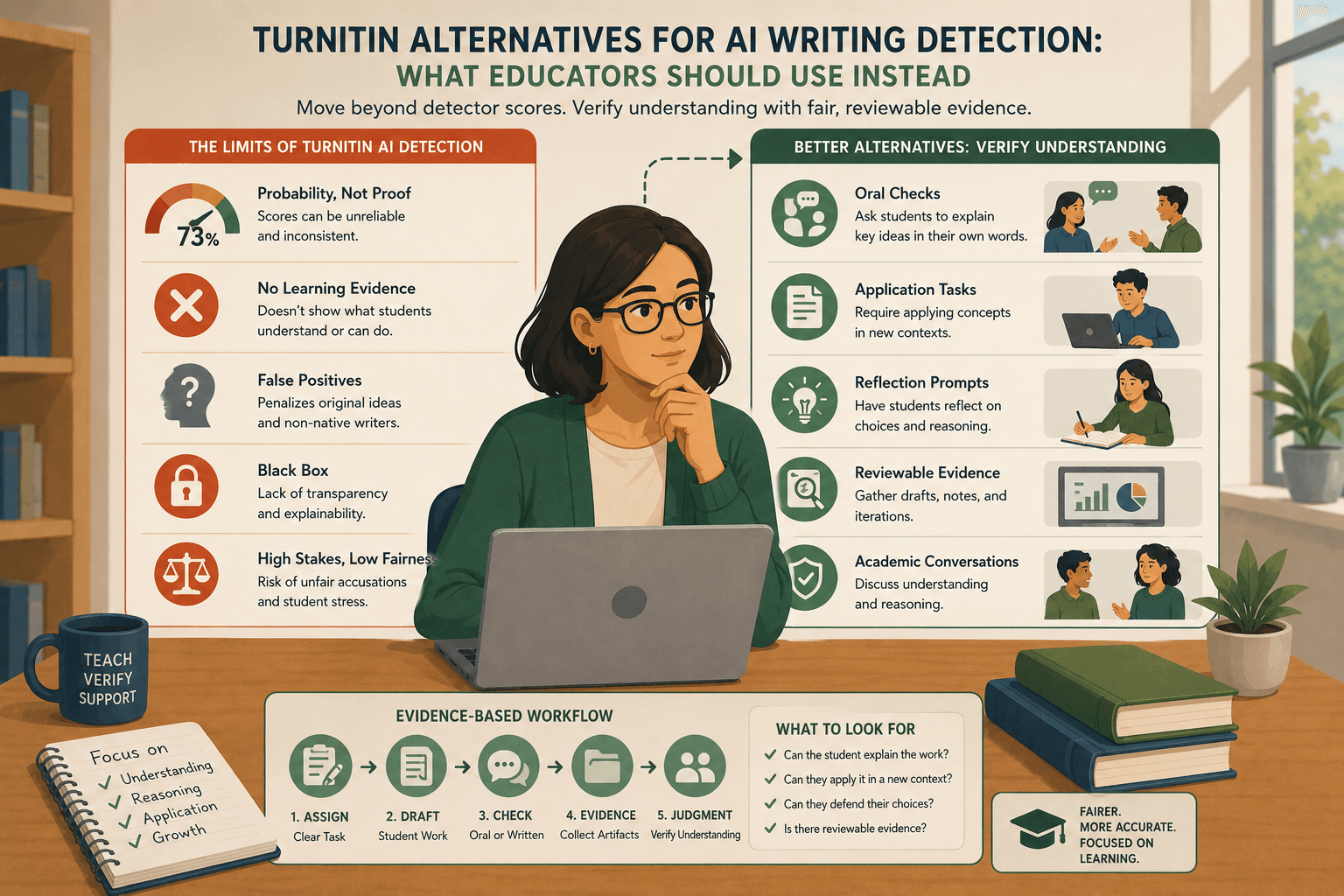
Turnitin says its AI writing detection model may misidentify human-written, AI-generated, and AI-paraphrased text, and that it should not be used as the sole basis for adverse action against a student.1 That is the important sentence. If your current process treats a percentage as evidence of misconduct, you do not need a slightly better detector. You need a better assessment workflow.
Why educators are looking for Turnitin alternatives
Most instructors are not looking for alternatives because they want weaker standards. They are looking because AI writing scores can create a new kind of burden: you see a suspicious result, you are not sure how much weight it deserves, and now you have to decide whether to confront a student, escalate the case, redesign the assignment, or ignore the flag.
Turnitin has acknowledged that false positives are a major concern for instructors and administrators.2 It also changed how low AI writing scores are displayed, noting that scores below 20 percent are less reliable and are no longer surfaced as ordinary percentages in newer reports.1 That is a responsible warning, but it also shows why the output should not be treated like a final answer.
| If your problem is | A detector can help with | A detector cannot prove |
|---|---|---|
| A paper feels inconsistent | Starting a closer review | That the student cheated |
| A score is high | Identifying where to ask questions | That the student lacks understanding |
| A score is low | Reducing one kind of concern | That the student wrote everything independently |
| A student disputes the result | Opening a conversation | That the accusation is fair |
| A department needs consistency | Standardizing triage | Replacing assessment judgment |
The strongest Turnitin alternative is not simply another AI checker. It is a process that helps you answer the question that actually matters: Can this student explain, apply, and defend the work they submitted?
The problem with replacing one score with another score
It is tempting to compare AI detectors by accuracy claims. Tool A says it has a low false-positive rate. Tool B says it has better benchmarks. Tool C says it can detect paraphrased AI. Those comparisons can be useful for procurement, but they do not solve the classroom problem.
The classroom problem is that every detector score becomes personal when it lands on a student. A one percent false-positive rate can sound small in a product claim, but it is not small to the student who is wrongly accused. It is also not small to the instructor who must justify the next step.
Brandeis University summarizes a common academic concern: AI detection tools can be unreliable, can be biased against some student groups, and can be evaded through rewriting or obfuscation.4 The University of Texas at Austin goes further on institutional governance. Its guidance emphasizes assessment design over policing and warns that third-party AI detection software can create privacy, intellectual property, accessibility, contracting, and FERPA concerns when used outside approved university processes.3
So the better question is not, "Which detector has the best percentage?" The better question is, "What decision are we making, and what evidence is fair enough to support that decision?"
What a better Turnitin alternative should do
A useful alternative should reduce uncertainty rather than create a new dispute. It should help you move from suspicion to reviewable evidence. That means the tool should be built around student understanding, not just authorship probability.
| Requirement | Why it matters | What to look for |
|---|---|---|
| Evidence after submission | AI use is often ambiguous from the text alone | Short explanations, oral checks, process artifacts, and concept questions |
| Human review | Academic integrity decisions need context | Instructor-visible evidence, not automated punishment |
| Clear student experience | Students should know what is expected | Transparent prompts and consistent follow-up steps |
| Accessibility and fairness | Writing style varies across students | Multiple ways to demonstrate understanding |
| Institutional consistency | Departments need repeatable workflows | Shared rubrics, review records, and escalation thresholds |
This is where Pruuva's approach differs from detector-centered tools. Pruuva does not ask instructors to guess whether a text pattern is human or AI. It helps instructors collect capability evidence, which is structured proof that a student can explain the reasoning behind the work.
That evidence can include a short oral explanation, a concept defense, a revision rationale, a problem-solving check, or a targeted follow-up tied to the submitted assignment. The goal is not to scare students away from AI. The goal is to make sure the final submission still reflects learning.
When Turnitin still has a place
This is not an argument that every institution should abandon Turnitin. Many schools already rely on Turnitin for similarity checking, feedback workflows, and assignment review. It can still be useful as one signal inside a broader academic integrity process.
The problem starts when the AI writing score becomes the process.
A healthier model is to treat detection as triage. If a result raises a concern, the next step should be a learning-centered check. That check should ask the student to demonstrate what the paper alone cannot show.
| Stage | Detector-centered workflow | Evidence-centered workflow |
|---|---|---|
| Submission | Run AI writing scan | Review assignment against learning goals |
| Concern | Interpret score as suspicious | Identify what understanding needs verification |
| Follow-up | Confront student about authorship | Ask student to explain, apply, or revise specific parts |
| Decision | Weigh score and student response | Weigh reviewable evidence against course expectations |
| Record | Save report output | Save evidence, rubric notes, and next steps |
The evidence-centered workflow is fairer because it does not require the instructor to prove the impossible. It asks the student to show what they know.
Practical workflow: what to do instead of relying on Turnitin AI scores
Start by deciding what the assignment was meant to measure. If the goal was literary analysis, ask the student to explain how they chose a passage and how the evidence supports the claim. If the goal was research synthesis, ask how the student evaluated sources and resolved conflicting evidence. If the goal was problem-solving, ask the student to apply the same concept to a small new case.
Then create a standard follow-up path. Students should not experience the process as a surprise interrogation. They should understand that follow-up checks are part of the course's assessment design, especially in an AI-enabled environment.
A simple workflow looks like this:
- Review the submitted work for the specific learning outcome at issue.
- Identify two or three points that would be difficult to explain without genuine understanding.
- Ask the student to complete a short structured evidence check.
- Evaluate the response with a rubric that was disclosed in advance.
- Record the evidence and apply the same process consistently across students.
The key is consistency. If you only ask some students to explain their work because a detector score made you suspicious, you risk turning the detector into a hidden gatekeeper. If you build evidence checks into the assignment design, the process becomes a normal part of learning.
How Pruuva fits into a Turnitin alternative strategy
Pruuva is best understood as an alternative to the AI detection decision layer. It helps educators verify whether students can stand behind their work.
That matters because the future of academic integrity will not be won by trying to ban every possible writing assistant. Students will use AI for brainstorming, editing, outlining, and feedback. Some uses will be allowed. Some will not. The institution still needs a way to verify learning without collapsing every case into a debate about probability scores.
With Pruuva, the instructor can set the kind of evidence required, review a student's explanation, and make a decision based on demonstrated understanding. That creates a stronger record than a screenshot of an AI percentage.
| If you currently use Turnitin for | Keep using it for | Add Pruuva for |
|---|---|---|
| Similarity checking | Source overlap and citation review | Understanding checks after submission |
| AI writing reports | Triage and caution signals | Evidence-based follow-up |
| Academic integrity workflows | Documentation and escalation | Student explanation and capability evidence |
| Department consistency | Shared review infrastructure | Consistent evidence standards |
The point is not to replace every part of the existing stack. The point is to stop asking detector scores to do work they were not designed to do.
The best alternative is a better standard of evidence
If you are comparing Turnitin alternatives, look beyond the product category. Ask whether the tool helps you make a fair academic decision.
A fair decision needs more than a probability estimate. It needs a clear learning outcome, a consistent follow-up process, and evidence the student can review, respond to, and understand.
That is the shift Pruuva is built around. AI has changed what a submitted document can prove by itself. It has not changed the need for students to understand their work. The stronger workflow is not detection alone. It is detection, if used at all, followed by structured evidence of understanding.