How to Create a Student AI Use Policy That Supports Authentic Assessment
A practical guide for writing student AI use policies that clarify expectations, protect academic integrity, and verify learning through authentic assessment evidence.
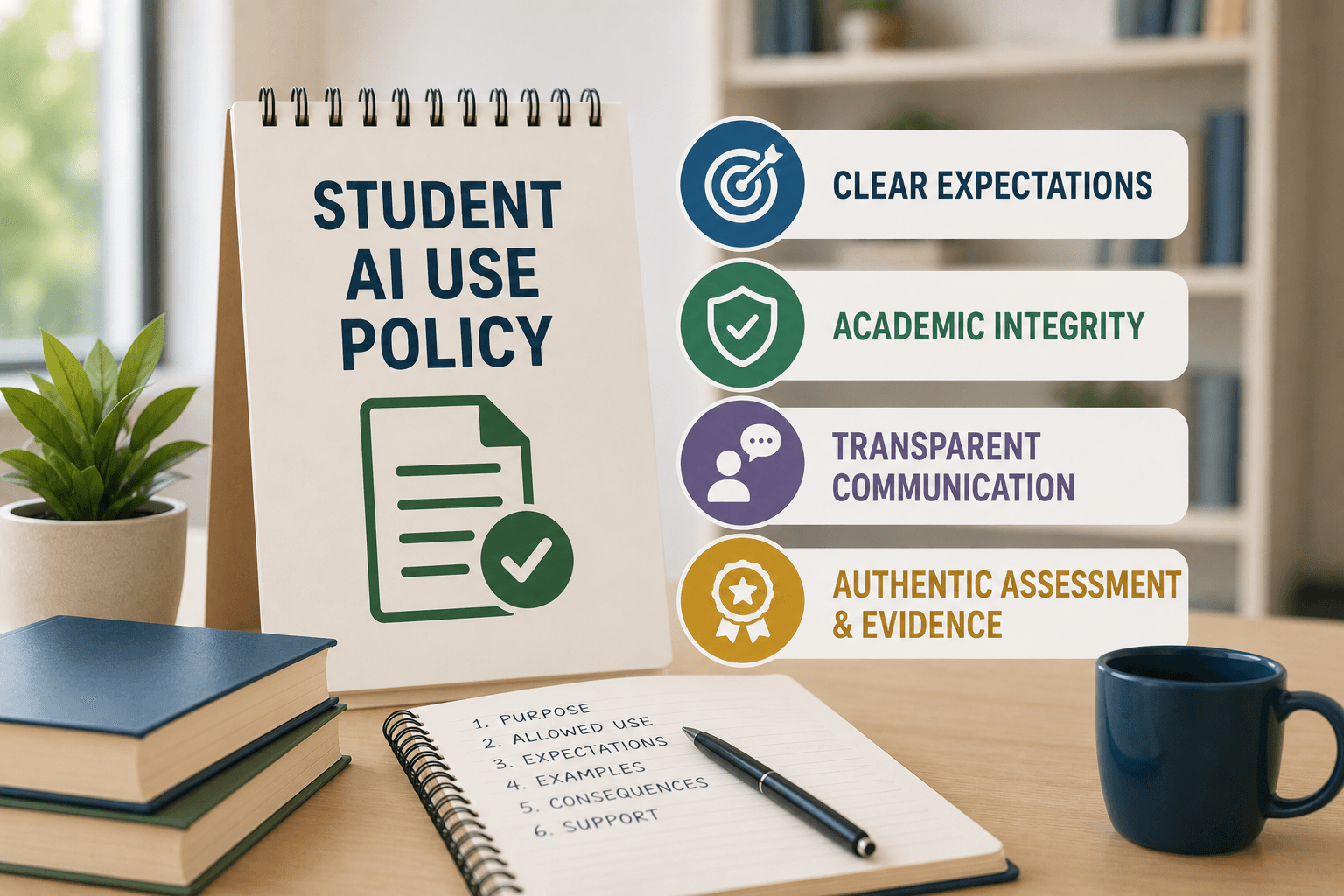
A student AI use policy should do more than warn students not to cheat. It should tell students how learning will be judged in a world where AI tools are available.
That distinction matters. A policy that only says "do not use AI" may feel clear, but it often fails in practice. Students may not know whether brainstorming, grammar support, translation help, citation cleanup, tutoring, outlining, or feedback counts as AI use. Instructors may apply the rule differently. Departments may discover that enforcement depends on unreliable AI detection.
A better policy starts with the learning goal. It explains what help is allowed, what help is not allowed, what students must disclose, and how they will demonstrate understanding.
Why AI policy needs authentic assessment
Generative AI changed the meaning of many take-home assignments. A polished submission no longer proves the same thing it once did. That does not mean essays, projects, reports, or reflections are useless. It means the assessment must include evidence that connects the final product to the student's understanding.
Teachers College, Columbia University recommends transparent discussion of AI expectations, assignment learning goals, privacy, intellectual property, credit, syllabus statements, rubrics, flexible assignments, and student participation in class planning.1 Cornell's teaching guidance similarly frames AI and academic integrity around clear expectations, assignment design, and meaningful learning tasks rather than detection alone.2
| Weak policy question | Stronger policy question |
|---|---|
| "How do we stop students from using AI?" | "What uses of AI support or undermine the learning outcome?" |
| "How do we catch AI writing?" | "How will students show they understand the work?" |
| "What tool can enforce this?" | "What evidence will support a fair decision?" |
| "What should the syllabus forbid?" | "What should students be able to explain, apply, and defend?" |
That shift makes the policy more realistic. It also makes it easier to enforce fairly.
Start with three categories of AI use
Students need plain language. If the policy is too abstract, they will guess. If every instructor uses different terms, they will carry assumptions from one course into another.
A useful course policy can divide AI use into three categories.
| Category | Meaning | Example policy language |
|---|---|---|
| Allowed | AI use supports learning and does not replace the assessed work | "You may use AI for brainstorming, study questions, and grammar suggestions, but you must make the final decisions and understand the submitted work." |
| Conditional | AI use is allowed only if disclosed or used in specific ways | "You may use AI for outlining if you disclose the tool, prompt, and how the output changed your approach." |
| Prohibited | AI use replaces the learning being assessed | "You may not submit AI-generated analysis, code, citations, or answers as your own work when the assignment measures your ability to produce that work." |
This structure helps students make decisions before they submit. It also gives instructors a consistent way to explain expectations.
Tie every rule to a learning outcome
AI policy becomes much easier to defend when every rule connects to what the course is trying to teach.
If the assignment measures first-draft fluency, AI drafting may undermine the goal. If the assignment measures revision judgment, AI feedback may be acceptable if the student explains which suggestions they accepted and why. If the assignment measures research synthesis, AI-generated citations may be prohibited because they can fabricate sources and weaken the student's evidence trail.
| Learning outcome | AI use that may support learning | AI use that may undermine learning |
|---|---|---|
| Understand a concept | Asking AI for practice questions | Submitting AI's explanation as the student's own |
| Develop an argument | Brainstorming possible counterarguments | Generating the thesis and full analysis |
| Improve writing clarity | Grammar and readability feedback | Rewriting the whole paper without student judgment |
| Learn research methods | Asking for search terms | Inventing citations or summaries |
| Practice coding | Asking for syntax explanation | Submitting generated code the student cannot explain |
This approach prevents the policy from becoming a list of tool names. Tool names change. Learning outcomes last longer.
Require disclosure where it matters
Disclosure should be useful, not performative. If students are required to disclose every spellcheck or grammar suggestion, the process becomes noisy. If they disclose nothing, instructors lose important context.
A practical disclosure rule should focus on AI assistance that meaningfully shaped the work.
Ask students to disclose:
- The tool or system used.
- The purpose of use.
- The prompt or type of prompt when relevant.
- The parts of the submission affected.
- What the student changed, accepted, rejected, or learned.
A short disclosure statement can be enough:
I used an AI tool to generate possible counterarguments for my essay. I selected two that were relevant, rejected one because it did not match the course reading, and wrote the final analysis myself.
That statement gives the instructor context. It also asks the student to take responsibility for judgment.
Do not make AI detection the enforcement plan
Detection may be one signal, but it should not be the core policy mechanism. The University of Texas at Austin emphasizes proactive assessment design over policing and warns that third-party AI detection can create privacy, accessibility, intellectual property, FERPA, contracting, and personal liability concerns when used outside approved university processes.3
UNESCO's guidance also emphasizes that institutions should address generative AI through policy, governance, human-centered values, teacher capacity, and appropriate pedagogical use, rather than treating AI as only a misconduct detection problem.4
The enforcement plan should focus on evidence.
| If concern arises | Weak response | Stronger response |
|---|---|---|
| Writing style changes | Run multiple detectors until one confirms suspicion | Ask the student to explain specific choices and sources |
| Disclosure seems incomplete | Assume misconduct | Ask for clarification and process evidence |
| Student cannot explain work | Debate whether AI was used | Evaluate understanding against the rubric |
| Department sees repeated issues | Add stricter bans | Redesign assignments and standardize evidence checks |
This does not mean misconduct should be ignored. It means the process should produce evidence that can support a fair decision.
Build evidence checks into the policy
A strong AI use policy should tell students that they may be asked to explain their work. This should not feel like a surprise interrogation. It should be a normal part of assessment.
Pruuva supports this evidence layer. Instructors can use structured checks that ask students to explain, apply, defend, or revise work in ways that connect directly to the assignment goals.
| Evidence check | Policy language |
|---|---|
| Oral explanation | "You may be asked to explain key decisions in your submission in your own words." |
| Source defense | "You may be asked to explain why your sources were selected and how they support your claims." |
| Revision rationale | "You may be asked to describe how feedback or tools shaped your revisions." |
| Concept transfer | "You may be asked to apply the same concept to a new example." |
| AI disclosure review | "You may be asked to discuss how any disclosed AI assistance affected your final work." |
When this expectation is disclosed in advance, follow-up checks feel less punitive. They become part of how the course verifies learning.
Sample syllabus language
You can adapt this language to your course:
In this course, AI tools may be used only when they support the learning goals of the assignment and do not replace the work being assessed. For each assignment, I will specify whether AI use is allowed, conditional, or prohibited. If you use AI in a way that materially shapes your submitted work, you must disclose the tool, purpose, and how you used or changed the output. You remain responsible for the accuracy, originality, citations, reasoning, and final decisions in your work. I may ask you to complete a short evidence check, such as explaining your reasoning, defending a source choice, applying a concept to a new case, or describing your revision process. These checks are used to verify understanding and will be evaluated according to the assignment goals.
This language does three important things. It permits responsible use where appropriate. It requires ownership. It tells students that understanding, not just output, is what counts.
Create a department-level version
Individual instructors need flexibility, but students also need consistency. A department-level policy can define shared categories, minimum disclosure expectations, and a standard approach to follow-up evidence.
| Department-level element | Why it helps |
|---|---|
| Shared definitions | Reduces confusion across courses |
| Assignment-level AI labels | Lets instructors set context-specific rules |
| Disclosure template | Gives students a repeatable habit |
| Evidence-check protocol | Prevents ad hoc accusations |
| Escalation pathway | Separates learning follow-up from misconduct proceedings |
| Faculty guidance | Helps instructors respond consistently |
This is where institutions often struggle. They write a policy statement, but they do not operationalize it. Pruuva helps bridge that gap by giving faculty a practical way to collect and review evidence of understanding.
The practical recommendation
Your AI use policy should not depend on perfect detection. It should depend on clear expectations and authentic assessment evidence.
Tell students what AI use is allowed. Tell them what must be disclosed. Tell them what remains their responsibility. Then design assignments and follow-up checks that require students to explain the work they submit.
That is the durable path. Tools will change. Policies will evolve. But students still need to learn, and educators still need a fair way to verify that learning.