What to Do When an AI Detector Flags a Student
A practical, fair workflow for educators who receive an AI detector flag and need to respond without turning a probability score into an accusation.
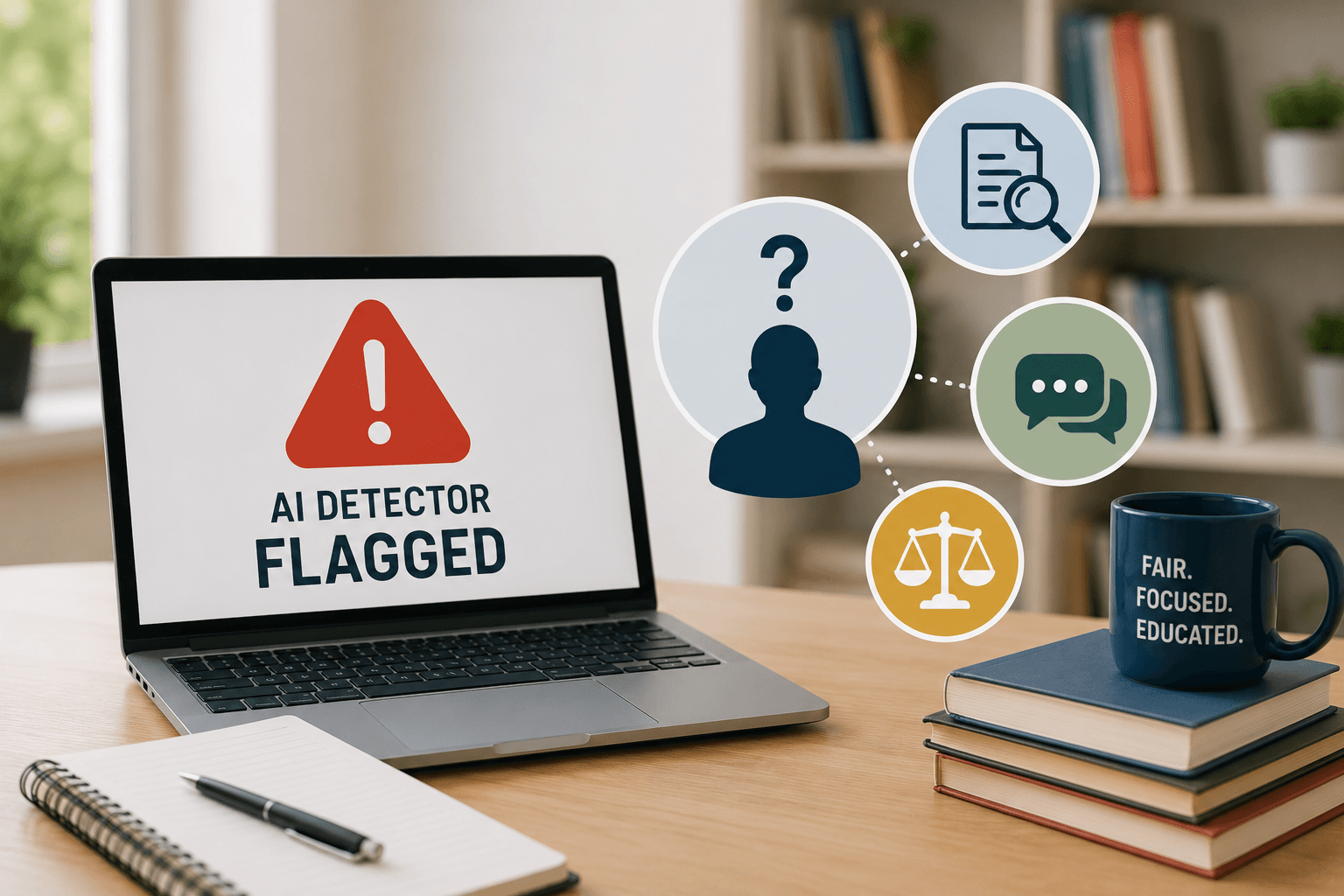
An AI detector flag can feel urgent. You open a student submission, see a high percentage, and suddenly the paper is no longer just a paper. It is a decision point.
The hardest part is that the flag does not tell you what to do next. It does not know your assignment goals, your syllabus policy, the student's writing history, whether the student used Grammarly, whether the student is multilingual, whether the student received allowed feedback, or whether the tool is wrong. It gives you a signal. You still have to make an academic judgment.
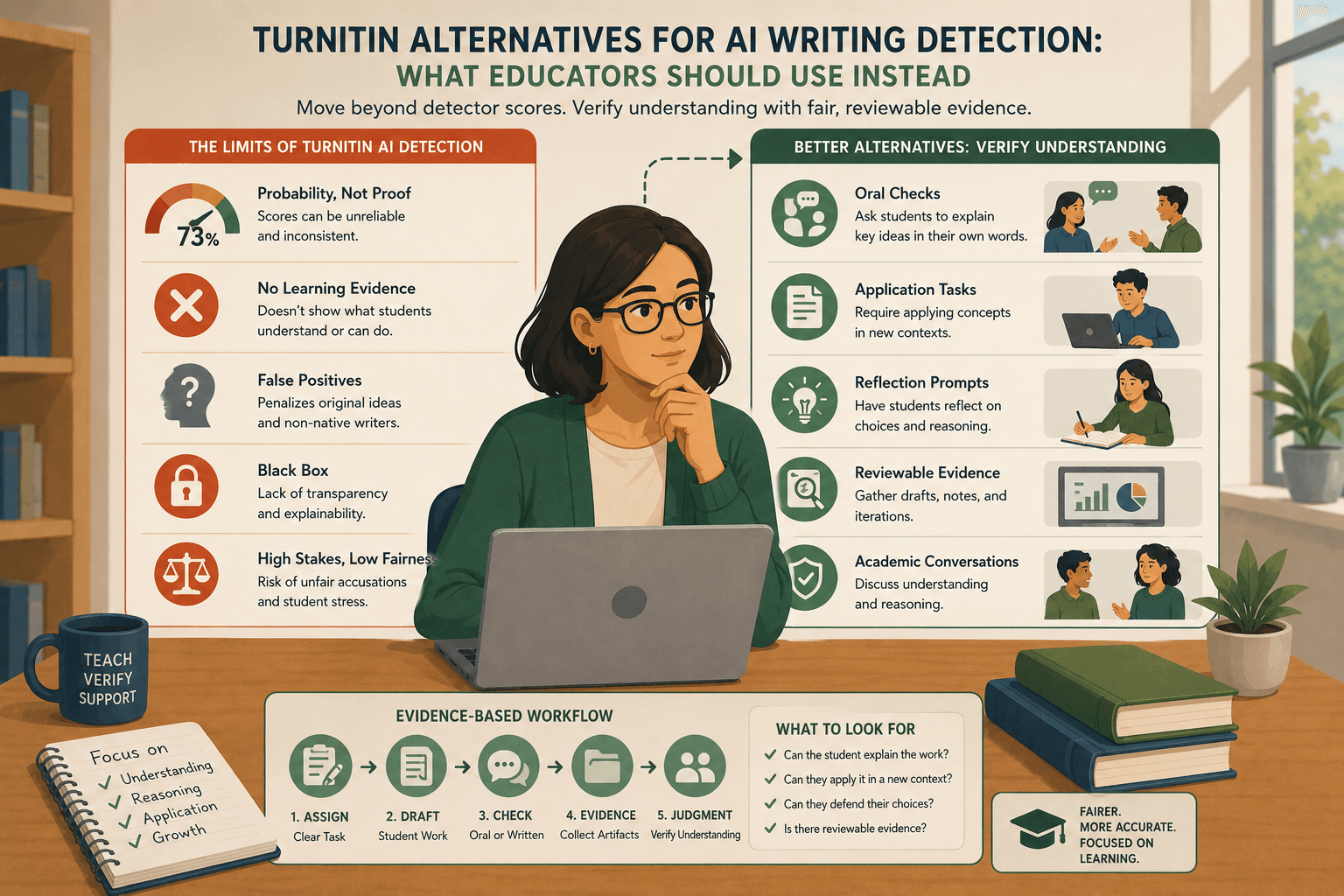
That is why the safest first move is simple: do not treat an AI detector flag as an accusation. Treat it as a reason to gather better evidence.
Why a flag is not enough
AI checkers estimate probability. They look for patterns that resemble machine-generated text and return a confidence score or classification. The University of Nebraska describes these systems as probability tools and warns that confidence scores can create problems for students who use writing support tools, students learning English, and neurodivergent writers.1
TRAILS at the University of Maryland summarizes the larger concern directly: practical AI detection may be unreliable, false positives can have serious consequences, and educators may need to adapt assessment rather than police AI use through detection alone.2
| What you have | What it can suggest | What it cannot decide |
|---|---|---|
| A detector percentage | The text pattern may deserve closer review | The student cheated |
| A highlighted passage | A section may need explanation | The student lacks understanding |
| A sudden style change | The submission may need context | The source of the change |
| A student denial | The student disputes the signal | Whether the work reflects learning |
| A prior writing sample | Useful comparison context | A complete authorship record |
When the stakes include a misconduct allegation, the standard of evidence has to be stronger than a probability score.
Step 1: Pause before contacting the student
The first step is not a message to the student. It is a pause.
Before you contact anyone, check your own process. What does your syllabus say about AI use? Did the assignment instructions clearly define allowed and prohibited assistance? Did you tell students that AI detection might be used? Does your institution have a policy for detector outputs? Does the tool you used have institutional approval?
This matters because the University of Texas at Austin warns that third-party AI detection software can raise privacy, accessibility, intellectual property, FERPA, contracting, and personal liability concerns when used outside approved university processes.3
If the process itself is unclear, slow down. A messy process can turn a questionable flag into an unfair case.
Step 2: Identify the learning outcome at risk
Do not start with, "Did the student use AI?" Start with, "What learning outcome might not have been demonstrated?"
That shift changes the entire conversation. Instead of trying to prove authorship from text pattern analysis, you are asking whether the student can explain, apply, and defend the work.
| Assignment type | Learning outcome to verify | Strong follow-up prompt |
|---|---|---|
| Analytical essay | Evidence selection and interpretation | "Walk me through why you chose this passage and how it supports your claim." |
| Research paper | Source evaluation and synthesis | "Explain how two of your sources disagree and how you resolved the tension." |
| Lab report | Method reasoning and data interpretation | "What would change in your conclusion if this variable moved in the opposite direction?" |
| Reflection | Personal connection and judgment | "Which claim in your reflection changed as you drafted, and why?" |
| Problem set | Transfer of method | "Solve a similar case and explain each step." |
This step protects both sides. It protects the student from being judged by a black-box score, and it protects the instructor from making a case around weak evidence.
Step 3: Review the submission for specific evidence needs
Read the paper with a narrower goal. You are not trying to find every suspicious sentence. You are looking for two or three points where a student with real understanding should be able to explain the reasoning.
Choose points that connect directly to the assignment. Avoid vague prompts like, "Did you write this?" That question invites denial, defensiveness, and confusion. Use prompts that reveal understanding.
For example, if the paper uses a sophisticated concept from week six, ask the student to explain that concept in simpler terms and connect it to a class discussion. If the conclusion makes a strong claim, ask what evidence would weaken it. If the paper cites a source, ask how the source shaped the argument.
The goal is not to trap the student. The goal is to give them a fair opportunity to show the learning behind the work.
Step 4: Use a structured evidence check
A structured evidence check is a short, consistent follow-up that asks the student to demonstrate capability. It can be written, oral, asynchronous, or live. The format matters less than the consistency.
Pruuva is built for this part of the workflow. Instead of asking you to make a decision from a detector score, Pruuva helps you collect capability evidence that can be reviewed against the assignment goals.
| Evidence check | Best use case | What it reveals |
|---|---|---|
| Short oral explanation | Essays, projects, reports | Whether the student can explain reasoning in their own words |
| Revision rationale | Draft-based assignments | Whether the student understands changes and tradeoffs |
| Concept transfer | Problem-solving assignments | Whether the student can apply the idea in a new context |
| Source defense | Research assignments | Whether the student understands source relevance and limits |
| Process reflection | Creative or iterative work | Whether the student can describe decisions made during production |
The check should be limited. You do not need to re-grade the entire course. You need enough evidence to make a fair judgment about the specific concern.
Step 5: Keep the student conversation neutral
The tone of the first message matters. A detector flag already creates anxiety. If your message sounds like a verdict, the student is likely to respond as if they are defending themselves in a disciplinary process.
A better message is direct and neutral:
I am following up because I need to verify the learning represented in your submission. This does not mean a decision has been made. I will ask you to complete a short evidence check connected to the assignment goals, and I will evaluate that evidence using the same standard applied to other students.
That kind of message makes the process clear. It avoids saying the student cheated. It also avoids pretending the concern does not exist.
Step 6: Evaluate the evidence, not the panic
Some students explain themselves well under pressure. Others do not. Some students are confident even when they do not understand the work. Others understand the work but freeze in a live conversation.
That is why you need a rubric. A fair follow-up does not measure confidence. It measures evidence.
| Criterion | Strong evidence | Weak evidence |
|---|---|---|
| Concept understanding | Student explains ideas accurately in their own words | Student repeats polished phrases without clarification |
| Source awareness | Student explains why sources were used and what they contributed | Student cannot connect sources to claims |
| Process ownership | Student describes choices, changes, and tradeoffs | Student cannot explain how the work developed |
| Transfer | Student applies the same idea to a nearby case | Student cannot use the concept outside the submitted text |
| Reflection | Student recognizes limits and alternatives | Student treats the paper as fixed text they cannot discuss |
If the evidence is strong, you may decide the detector flag should not carry weight. If the evidence is weak, you still have a clearer basis for next steps than the detector score alone.
Step 7: Record the decision carefully
A good record should show what happened, not just what the tool reported. Save the original concern, the student's response, the evidence check, the rubric notes, and the final decision.
This is where evidence reports matter. A report that documents the student's explanation and the instructor's review is more useful than a single AI percentage. It shows a process. It gives the student something concrete to respond to. It gives the institution a stronger basis for consistency.
What not to do
Do not paste student work into unapproved tools. Do not accuse a student based only on a percentage. Do not use a different follow-up process for students who write in a style you find unfamiliar. Do not make the conversation about whether the student can defeat a detector. Do not ignore your own syllabus policy.
Most importantly, do not let the tool decide what learning means in your course.
The better standard
A detector flag can be a starting point. It should not be the conclusion.
The better standard is evidence of understanding. If a student can explain the reasoning, defend the choices, apply the concept, and reflect on the work, you have stronger evidence than a detector can provide. If they cannot, you have a clearer and fairer reason to intervene.
That is the workflow Pruuva supports: fewer arguments over probability scores, and more reviewable evidence of what the student actually understands.