AI Detection Alternatives for Teachers: Verify Understanding Without Guessing Authorship
AI detection alternatives give teachers a fairer next step than probability scores: reviewable evidence that students can explain, defend, and apply the work they submit.
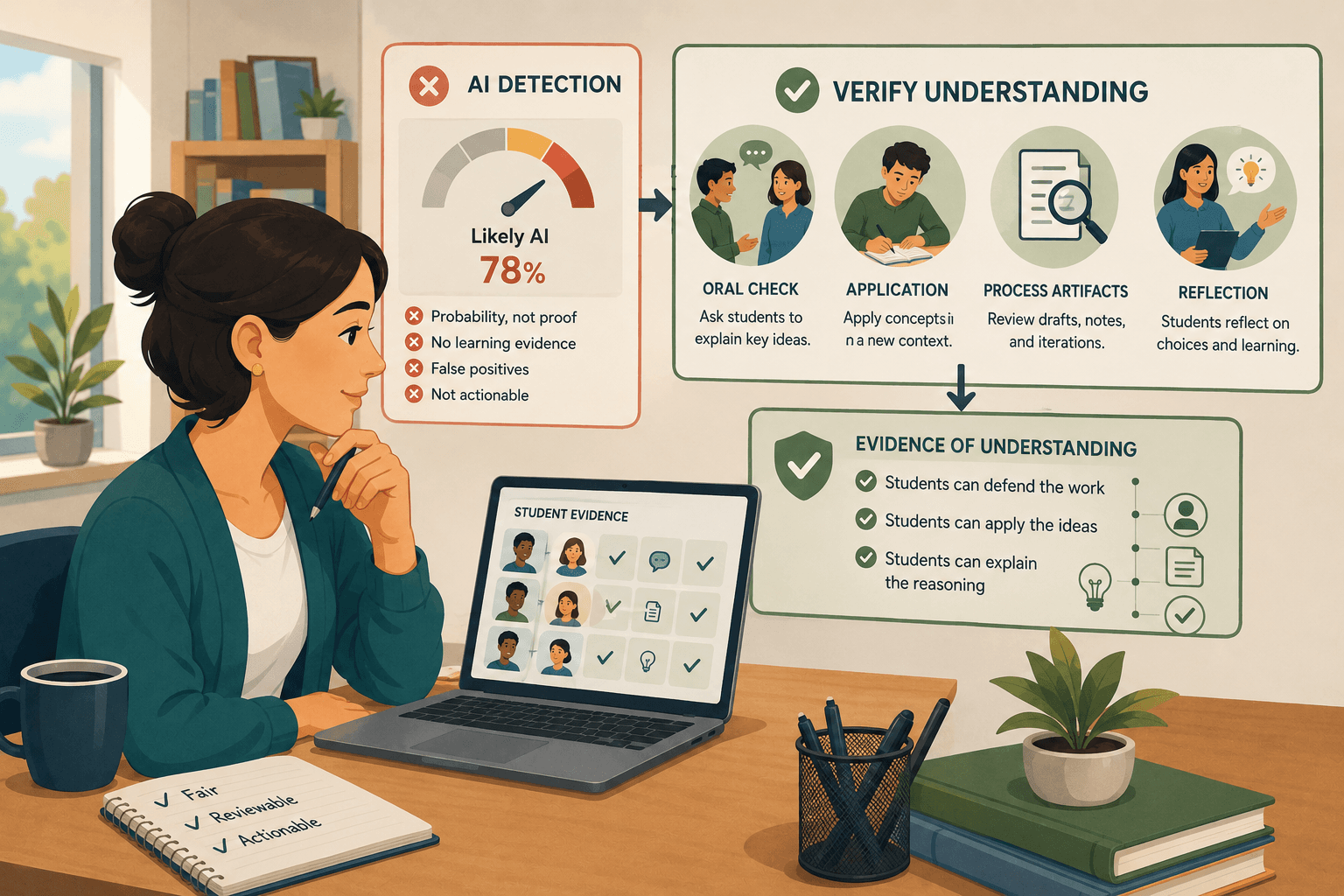
If you are searching for AI detection alternatives, you probably do not need another tool that promises a cleaner percentage. You need a fair way to answer the question that appears after the percentage shows up: what should you do next?
That is where many teachers get stuck. A student submits polished work. The voice feels different. The argument is stronger than usual. A detector returns a score that looks serious, but the score does not tell you whether the student understands the work, whether they used allowed support, whether they revised heavily, or whether the model is simply wrong.
This guide is for the teacher who wants a better next step. It explains what AI detectors can and cannot prove, then walks through practical alternatives you can use in writing, projects, labs, coding assignments, and online courses. The goal is not to pretend AI use is harmless. The goal is to create a review process that gives you evidence you can actually use.
Why educators are looking beyond AI detectors
AI detectors became popular because they offered speed at a moment when teachers were overwhelmed. You were asked to redesign assignments, interpret new student behavior, respond to AI policy questions, and protect academic standards at the same time. A scan button looked like relief.
The problem is that a scan button does not remove the judgment. It moves the judgment to a more fragile place. You still have to decide whether the score is meaningful, whether the student should be contacted, whether the case should be escalated, and whether the result is fair enough to affect a grade.
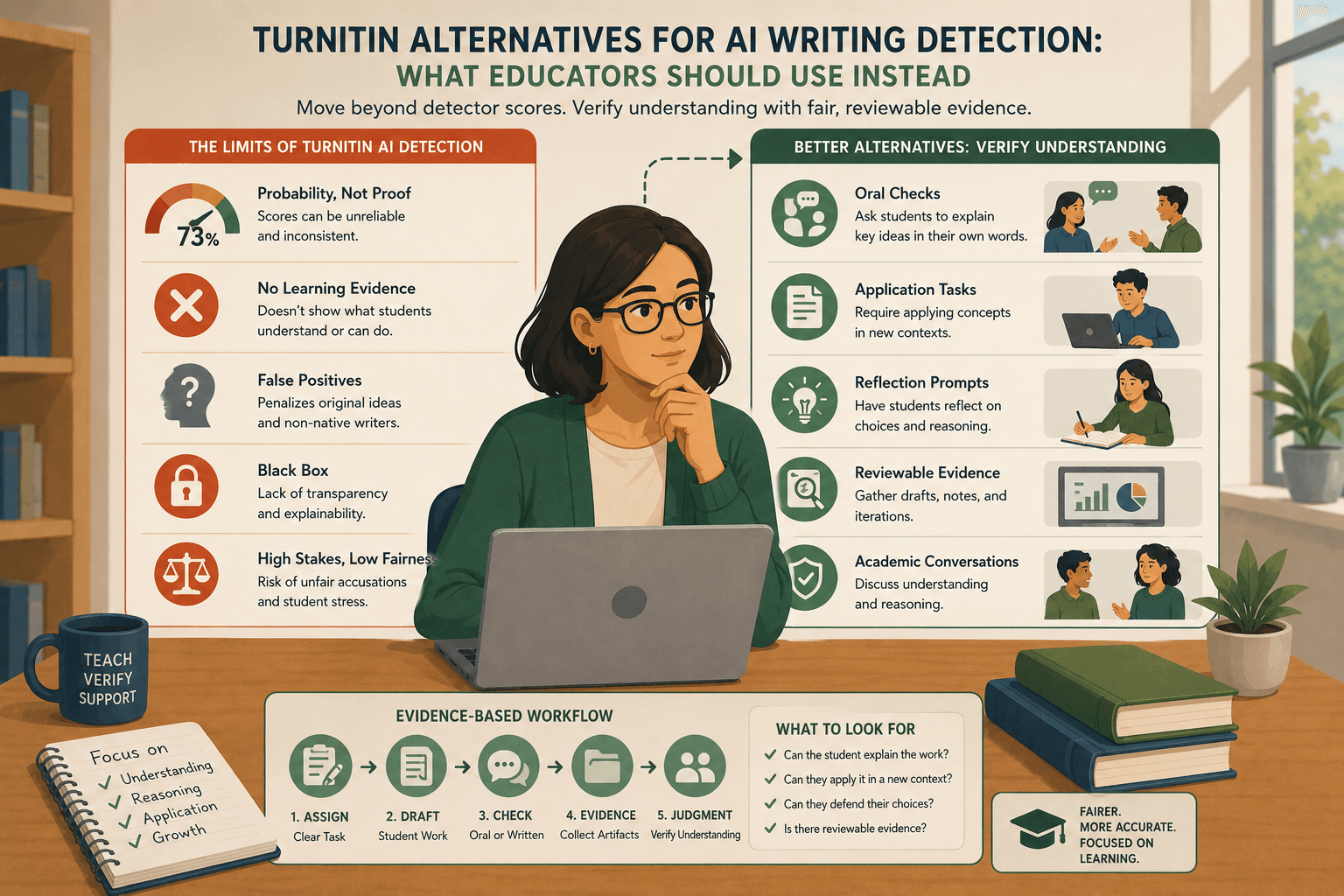
OpenAI’s own classifier page is a useful warning sign. OpenAI stated that its classifier was no longer available because of a low rate of accuracy, and its earlier evaluation identified only 26 percent of AI-written text as likely AI-written while incorrectly labeling 9 percent of human-written text as AI-written 1. Turnitin’s guidance also says its AI writing model may misidentify human-written, AI-generated, and AI-paraphrased text, so it should not be used as the sole basis for adverse action against a student 5.
Brandeis University’s AI guidance collects similar concerns and points educators toward research showing that detection tools can be unreliable, evasive, and biased against some student groups, including non-native speakers and students who are underrepresented in higher education 3. The University of Texas at Austin goes further in its campus guidance, emphasizing that academic integrity work should focus on effective course and assessment design rather than increasingly complex efforts to police students 2.
| What you need in a live teaching situation | What an AI detector usually gives you |
|---|---|
| A fair reason to start a conversation | A probability or classification about text |
| Evidence connected to the learning outcome | A signal about possible authorship |
| A process students can understand | A model output students may not be able to inspect |
| A record that supports instructor judgment | Highlights, percentages, and confidence language |
| A way to separate confusion from misconduct | A score that still requires interpretation |
When you look at the table closely, the pressure point becomes clear. The detector is not answering the same question you are responsible for answering.
What AI detectors can and cannot prove
An AI detector can sometimes raise a concern. It may identify patterns in text that resemble model-generated writing. It may be useful as one low-stakes signal when your institution allows it, the tool is properly procured, and the result is interpreted cautiously.
But a detector cannot prove the full academic integrity case by itself. It cannot observe the student’s thinking process. It cannot know whether a student used AI for brainstorming, translation, editing, outlining, or full drafting. It cannot evaluate whether AI use was allowed under your course policy. It cannot tell you whether a student can explain the concepts in their own submission.
This matters because education is not only about document provenance. It is about learning. If the learning outcome requires a student to construct an argument, interpret evidence, write code, explain a design choice, or apply a concept to a new case, then the review process needs to test those things.
A detector-centered workflow often looks decisive on the surface but fragile underneath.
| Detector-centered step | Hidden question left unresolved |
|---|---|
| Scan the submission | Was the tool appropriate for this genre, language, length, and context? |
| Review the percentage | What threshold actually justifies action in this course? |
| Compare with the student’s past work | Are you comparing learning growth, editing support, anxiety, translation, or outsourcing? |
| Contact the student | Are you beginning with inquiry or accusation? |
| Escalate if needed | What evidence will the reviewer use beyond the score? |
The danger is not only false positives. The danger is building an integrity process around evidence that does not match the decision you need to make.
UNESCO’s guidance on generative AI in education calls for human-centered, safe, equitable, and meaningful use of these technologies 4. In classroom terms, that means you need a process that protects learning and fairness at the same time. A detector score can sit inside that process only if it is not treated as the process.
Alternative workflows teachers can use
A strong AI detection alternative does not have to be complicated. It should help you move from suspicion to evidence. The best workflow depends on the assignment, the stakes, the time you have, and the kind of understanding you need to verify.
| Alternative workflow | Best fit | Evidence you collect | What to watch for |
|---|---|---|---|
| Process artifacts | Essays, research projects, portfolios, labs | Drafts, outlines, version history, notes, source trails | Students can overproduce artifacts if the requirement becomes performative |
| Reflection memos | Assignments involving judgment or tradeoffs | A short explanation of choices, constraints, and learning | Generic reflections are weak, so prompts must be specific |
| Targeted oral checks | Suspicious or high-stakes submissions | Student explanation connected to exact parts of the submitted work | Reviewers need consistent questions and notes |
| Revision conferences | Writing courses, capstones, design work | Student response to feedback and ability to improve the work | Time can become a constraint in large classes |
| Authentic transfer tasks | Applied courses, problem-solving assignments | Student applies the same concept to a new case | Prompt design matters more than tool choice |
| Clear AI-use declarations | Courses where some AI use is allowed | Student states what support they used and why | Declarations need follow-up norms, not just checkbox compliance |
The common thread is simple. Each alternative asks for evidence of understanding, not just evidence about a text. You are not trying to catch every possible misuse. You are making it harder for a submitted artifact to stand alone when the assignment depends on comprehension.
For many teachers, the most practical starting point is a short follow-up check. You do not need to interview every student for 20 minutes. You can focus on the submissions where the stakes are high, the evidence is unclear, or the assignment is central to the course outcome.
A useful follow-up check might ask the student to explain one claim, defend one method, interpret one source, walk through one line of code, or apply the same idea under a new constraint. The answer does not need to be perfect. It needs to give you enough context to understand whether the submitted work and the student’s demonstrated understanding belong together.
How Pruuva verifies understanding after submission
Pruuva is an academic integrity evidence platform, not an AI detector. That distinction matters.
An AI detector starts with the submitted text and estimates whether it resembles AI-generated writing. Pruuva starts with the submitted work and helps you collect evidence that the student can explain, defend, and apply what they turned in.
In practice, that means the submitted artifact becomes the basis for a structured follow-up rather than the endpoint of the investigation. Pruuva can help generate targeted oral checks connected to the student’s own work, capture the student’s responses, and organize the result into an evidence report that an instructor can review.
| If your current workflow asks... | An evidence workflow asks... |
|---|---|
| Did a model write this text? | Can the student explain this work? |
| Is the percentage high enough to act? | What follow-up evidence would clarify the concern? |
| Can I prove misconduct from the document? | Does the student’s explanation support the submitted artifact? |
| How do I defend this score? | What reviewable record supports my decision? |
This shift helps when AI use is prohibited, allowed with limits, or permitted for some stages of the work. In all three cases, you still need to understand whether the student achieved the learning outcome. A student who used AI appropriately should be able to explain their choices. A student who outsourced the work may struggle to connect their explanation to the submission. A student who is nervous or inarticulate may still show enough understanding when the questions are focused and fair.
That is why Pruuva’s workflow is designed around reviewable evidence rather than an accusation-first score. If you want to see how this works in detail, review Pruuva’s evidence reports or the broader guide to Pruuva for educators.
When to use comparison pages
Comparison pages are useful when your question has shifted from classroom tactics to tool evaluation. If you are choosing between an AI detector, plagiarism-first workflow, or evidence-based review process, you need different criteria than a feature checklist.
Use Pruuva’s AI detection comparison page when you need to compare workflows at the decision level. The question is not only which tool returns a score. The question is which workflow gives you a fair, reviewable basis for academic judgment.
| Decision you are making | Best next page |
|---|---|
| You rely on detector scores and want a fairer review process | Compare AI detection alternatives |
| You need documentation for instructor review or appeals | Explore evidence reports |
| You teach courses and want a practical integrity workflow | Pruuva for educators |
The best tool choice depends on what you need to prove. If you only need a low-stakes signal, a detector may have a limited role. If you need to make a student-facing academic decision, you need evidence that connects the student to the learning outcome.
FAQ
What is the best AI detection alternative for teachers?
The best alternative is a workflow that collects evidence of student understanding. For many teachers, that means targeted oral checks, process artifacts, reflection memos, revision conferences, or authentic transfer tasks. The right mix depends on the assignment and the stakes.
Are AI detectors always wrong?
No. The issue is not that every detector result is wrong. The issue is that a detector result is not enough, by itself, to decide whether misconduct occurred. Even vendor guidance warns that human judgment and additional scrutiny are needed before adverse action 5.
How can I verify student work without accusing the student?
Start with a neutral evidence-gathering frame. You can tell the student you want to understand their process and verify that they can explain key parts of the work. Ask questions tied to the submission and rubric, then document what the student can explain.
Can this work in large classes?
Yes, if you use it selectively and consistently. You do not need to run long oral exams for everyone. You can use short, structured checks for high-stakes assignments, unclear submissions, random sampling, or cases where a concern has already been raised.
Is Pruuva an AI detector?
No. Pruuva is an academic integrity evidence platform. It helps educators verify student understanding with structured follow-up questions, captured responses, and reviewable evidence reports.