Respondus LockDown Browser Alternatives for Assessment Integrity
A practical guide for institutions evaluating Respondus LockDown Browser alternatives and looking for ways to protect assessment integrity through evidence of understanding.
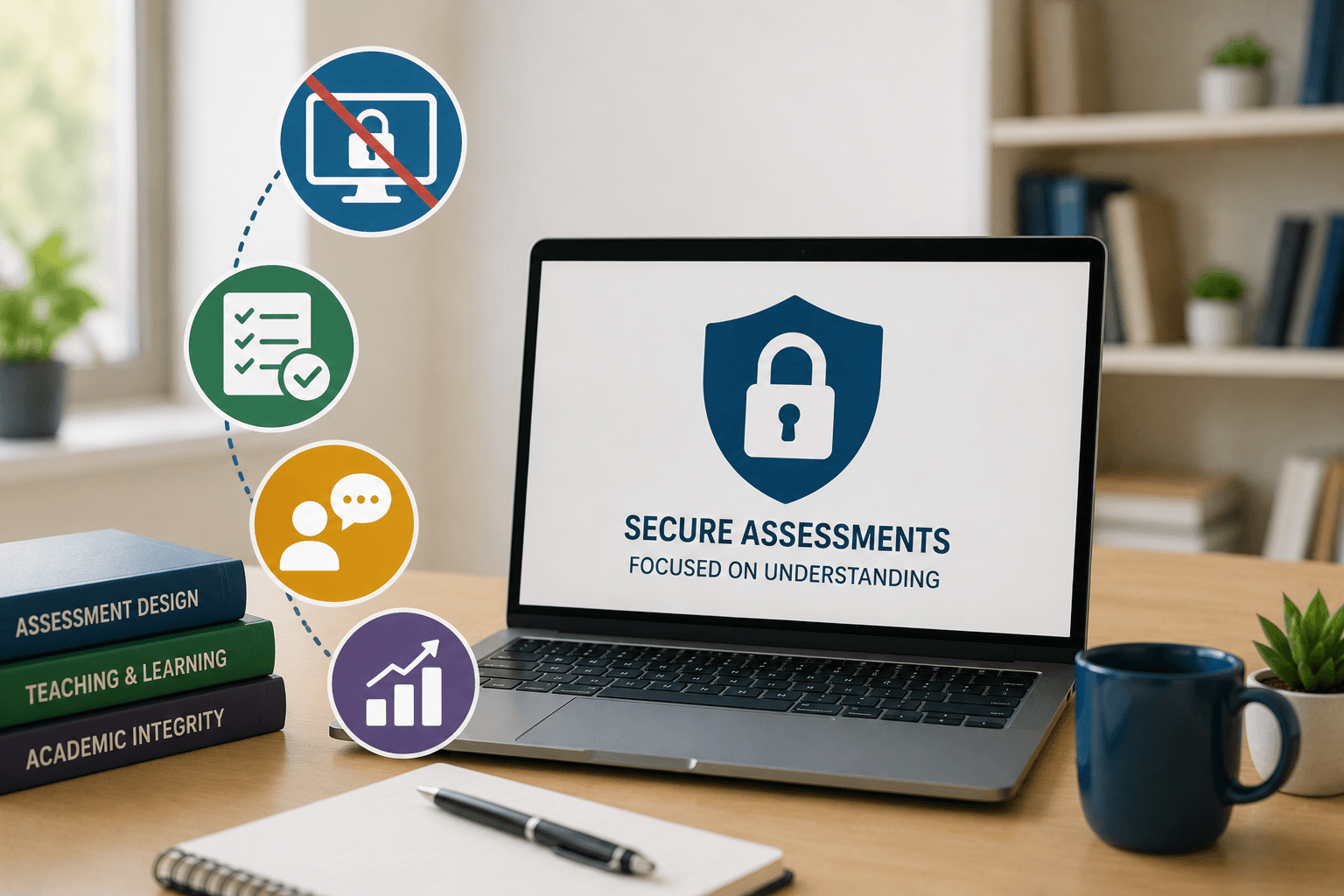
Respondus LockDown Browser solves a specific problem. It limits what students can access during an online assessment. Respondus describes the tool as a custom browser that locks down the testing environment inside a learning management system, preventing actions such as printing, copying, switching applications, accessing other websites, using screen capture, and running some remote or virtual environments.1
That can be useful when the assessment is a timed online exam and the institution needs tighter control over the test environment.
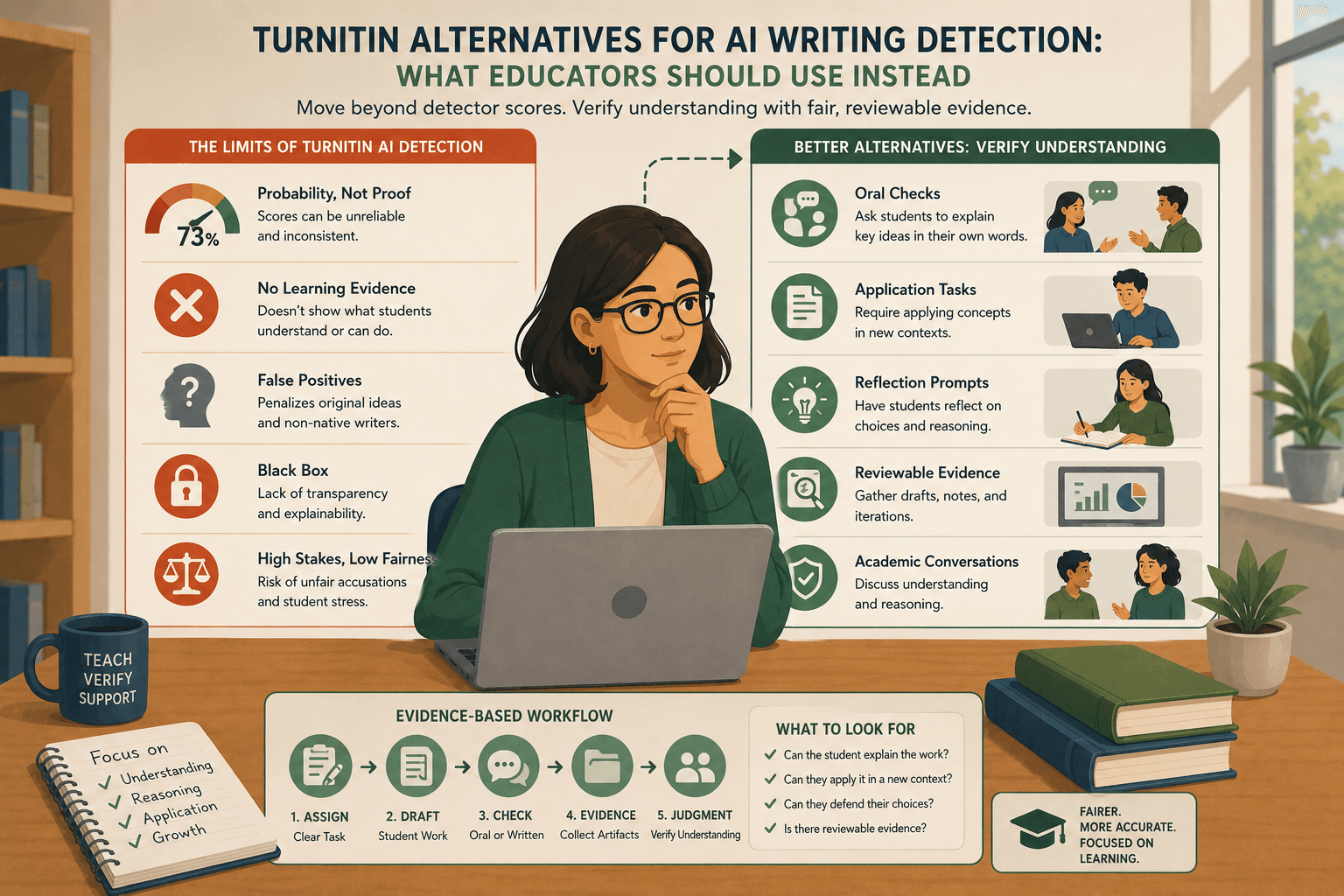
But lockdown is not the same as learning evidence. A locked browser can restrict a session. It cannot prove that a student understands the work, can explain the reasoning, or can transfer the concept to a new situation.
That is why institutions searching for Respondus alternatives should ask a broader question: Do we need more control over the browser, or do we need better evidence of understanding?
Why schools look for Respondus alternatives
Lockdown browsers became common because online testing created obvious integrity concerns. If a student can open another tab, message someone, paste content, or search for answers, the test no longer resembles the controlled classroom exam it was designed to replicate.
But the online assessment environment has changed. Students now have access to AI tools, browser extensions, writing assistants, paraphrasers, phones, second devices, and collaboration platforms. Trying to control every possible route to assistance can push institutions toward more restriction without necessarily creating better learning evidence.
A 2025 Open Praxis review of online proctoring systems explains that modern remote assessment tools often involve sensitive data, AI technologies, monitoring, authentication, flags, and post-exam review, while continuing to raise concerns around privacy, security, transparency, and how AI is used in decision-making.2
| If your concern is | Respondus may help by | Respondus may not answer |
|---|---|---|
| Students opening websites during a quiz | Restricting browser access | Whether the student understands the concept |
| Students copying test items | Limiting copy, print, and capture actions | Whether the assessment measures durable learning |
| Students using unauthorized software | Blocking application switching | Whether students can explain their reasoning |
| Faculty needing a familiar exam workflow | Preserving a test-like environment | Whether AI-era integrity needs a different design |
| Institutional consistency | Standardizing browser controls | Standardizing evidence of understanding |
The tool may still fit some exams. It just should not be mistaken for a complete academic integrity strategy.
The limitation of lockdown as a default strategy
A lockdown browser controls the device environment. Learning happens outside that narrow frame.
A student may memorize enough to pass a locked exam and still struggle to apply the material in a real task. Another student may use allowed tools while developing a project and still show strong independent understanding. A third student may know the material but face technical barriers that make a lockdown session stressful or unreliable.
Harvard Medical School notes that remote proctoring and online testing require clear processes, but it also frames remote assessment as an opportunity to improve question design and testing environments rather than relying only on monitoring.3
That is the important institutional lesson. If the assessment does not produce meaningful evidence, locking the browser may only protect a weak measurement.
What a stronger alternative should do
A strong Respondus alternative should not weaken standards. It should shift the standard from environmental control to capability evidence where appropriate.
| Requirement | Why it matters | Strong alternative |
|---|---|---|
| Verify understanding | Integrity is about whether learning occurred | Short concept checks and explanation prompts |
| Reduce unnecessary restriction | Not all work needs a locked browser | Purpose-limited follow-up evidence |
| Support authentic assessment | AI-era work often happens with tools present | Assignments that require application, reflection, and defense |
| Create reviewable records | Faculty need documentation | Evidence reports tied to rubric criteria |
| Scale across courses | One-off oral checks can overload instructors | Structured asynchronous or targeted verification workflows |
Pruuva fits this alternative category. It helps educators collect capability evidence from students after or alongside the submitted work. Instead of asking the browser to prove integrity, Pruuva asks the student to demonstrate understanding.
That evidence might be a short oral explanation, a written rationale, a source defense, a new applied problem, or a targeted concept check.
When Respondus still makes sense
There are cases where a lockdown browser is proportionate. Timed quizzes, large introductory exams, accreditation-sensitive assessments, and courses with external testing requirements may still need controlled online delivery.
The problem is not using Respondus where it fits. The problem is using lockdown as the default response to every academic integrity concern.
| Assessment type | Lockdown browser fit | Evidence-check fit |
|---|---|---|
| Timed objective exam | Stronger fit | Useful as targeted follow-up |
| Open-ended essay | Weak fit | Strong fit |
| AI-assisted project | Weak fit | Strong fit |
| Lab report | Weak to moderate fit | Strong fit |
| Capstone presentation | Weak fit | Strong fit |
| Low-stakes practice quiz | Often unnecessary | Usually unnecessary unless used for reflection |
This table points to a more balanced assessment architecture. Use environment control when the exam format genuinely requires it. Use evidence checks when the real question is whether the student can explain, apply, and defend the work.
A practical replacement workflow
If your program wants to reduce reliance on lockdown browsers, do not remove controls without replacing the evidence layer. Build a workflow that gives instructors a clear next step.
First, identify the assessments where lockdown is doing the most work. These are often large exams, high-stakes online quizzes, or courses with repeated integrity concerns.
Second, decide which of those assessments actually need to remain closed-book and timed. Some may. Others may be better redesigned as open-resource tasks, applied problems, oral checks, or projects with short verification steps.
Third, add structured evidence where the work matters most. You do not need to verify every minor quiz. You need to verify the submissions that carry significant weight or are most vulnerable to unsupported outsourcing.
| Current design | Better next step |
|---|---|
| Locked multiple-choice exam | Keep lockdown only if conditions matter, then add a short applied explanation for key outcomes |
| Take-home essay with no follow-up | Add a source defense or argument explanation |
| AI-permitted assignment | Require a rationale explaining what AI helped with and what the student decided |
| Project submission | Add a short process and concept check |
| Lab report | Ask the student to interpret a changed result or explain a method choice |
Pruuva helps manage this evidence layer in a repeatable way, which is the piece many institutions lack when they try to move away from lockdown-first assessment.
How to evaluate Respondus alternatives
When comparing options, avoid framing the decision as security versus trust. That framing is too simple. The stronger frame is evidence quality.
Ask these questions:
| Evaluation question | Why it matters |
|---|---|
| What learning outcome does this assessment need to prove? | Keeps the tool tied to pedagogy |
| Is browser control proportionate to the risk? | Prevents over-restriction |
| What evidence will remain after the assessment? | Supports review and feedback |
| Can students understand the rules before they submit? | Improves fairness |
| Can faculty apply the process consistently? | Protects standards across sections |
| Does the workflow reduce or increase disputes? | Measures practical usefulness |
The right answer may be a mixed model. Keep Respondus or another lockdown tool for assessments that truly need environmental control. Add Pruuva for the assessments where understanding is the core issue.
The practical recommendation
If your institution is evaluating Respondus alternatives, separate exam control from assessment integrity. They overlap, but they are not the same.
A lockdown browser can help protect a testing session. It cannot, by itself, verify learning. Pruuva helps fill that gap by collecting structured evidence that students understand the work they submit.
That shift matters because AI-era integrity cannot depend only on closing tabs. It has to depend on what students can actually explain and do.