Honorlock Alternatives: Academic Integrity Without Default Surveillance
A practical comparison guide for institutions evaluating Honorlock alternatives and looking for assessment integrity workflows that rely less on surveillance and more on evidence of learning.
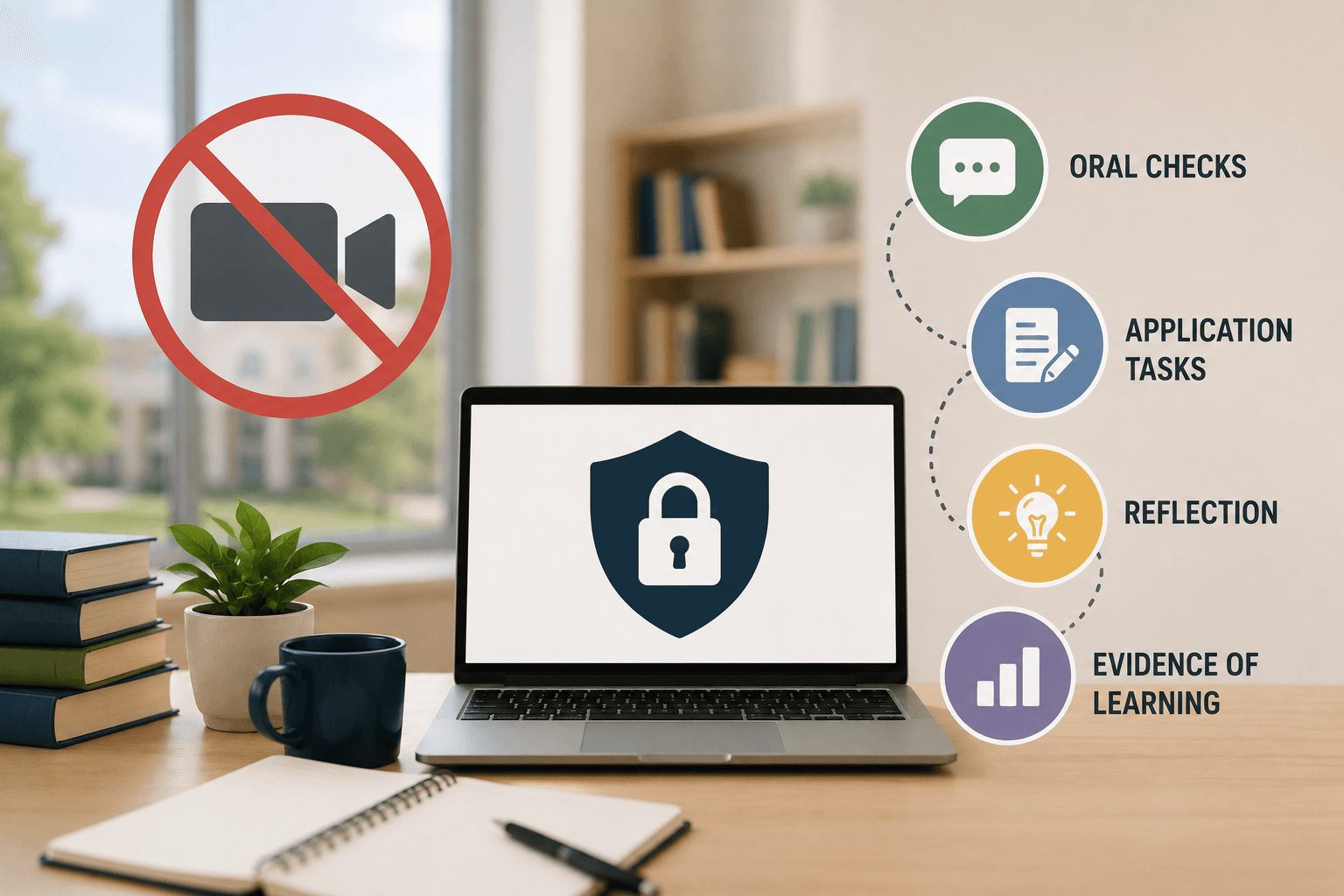
Honorlock is built for remote proctoring. It helps institutions monitor online exams with identity checks, browser controls, AI-assisted flagging, live proctor support, and related exam security features.1 If your institution needs to administer a high-stakes online test under controlled conditions, those capabilities can feel necessary.
But many academic integrity problems are not actually proctoring problems. They are assessment evidence problems.
If the question is, "Can we prevent every unauthorized behavior during a timed test?" a proctoring tool may be the category you review. If the question is, "Can this student explain and apply the work they submitted?" a surveillance-first tool is the wrong starting point.
That distinction matters for institutions evaluating Honorlock alternatives.
Why institutions look for Honorlock alternatives
Online proctoring expanded because colleges needed remote assessment continuity. The need was real. But the tools also changed the relationship between students, instructors, and the institution.
A 2025 Open Praxis review explains that online proctoring systems can collect and process sensitive data, including video, audio, screen data, biometric authentication signals, behavioral data, and flags related to potential exam violations.2 The same review highlights ongoing concerns around data privacy, security, transparency, and unspecified uses of AI in decision-making.2
Harvard Medical School also notes that remote proctoring creates student surveillance and privacy concerns, and that educators need clear processes and stronger assessment design to reduce cheating risks.3
| Institutional concern | Why Honorlock may be considered | Why an alternative may be needed |
|---|---|---|
| Remote exam security | Monitoring, identity checks, and lockdown controls | Not every assessment needs surveillance |
| Student privacy | Proctoring tries to protect exam integrity | Data collection can exceed the learning need |
| Faculty workload | Proctoring standardizes some exam processes | Flags still require review and judgment |
| Equity | Online exams can improve access | Surveillance can create unequal burdens across student environments |
| AI-era assessment | Proctoring controls the exam session | It does not verify understanding in open-work contexts |
The strongest alternative is not simply a different proctoring vendor. It is a different integrity model.
The problem with making surveillance the default
Surveillance can answer a narrow question: what happened during a controlled testing session? It is less effective for the broader question educators now face: how do we know submitted work reflects learning when students have access to AI, collaboration tools, tutors, browser extensions, and writing assistants?
Trying to solve every integrity concern with monitoring creates a mismatch. It pushes institutions toward more data collection even when the assessment problem would be better solved through design, explanation, and evidence.
A student can complete a locked-down exam honestly and still fail to transfer the concept. Another student can use allowed tools while developing a project and still demonstrate deep understanding. Surveillance alone does not tell you which learning outcome was met.
That is why institutions should separate three questions:
| Question | Best-fit response |
|---|---|
| Did the student follow exam conditions during a timed test? | Proctoring or controlled assessment environment |
| Did the student understand the submitted work? | Structured evidence check |
| Did the course design make expectations clear? | Transparent policy and authentic assessment design |
Honorlock belongs mostly in the first row. Pruuva is built for the second.
What an Honorlock alternative should provide
If your institution wants less default surveillance, the alternative should not lower standards. It should produce stronger evidence where monitoring is not the right tool.
| Requirement | Why it matters | What to look for |
|---|---|---|
| Evidence of understanding | Academic integrity is about learning, not only behavior control | Oral checks, concept defenses, source explanations, and applied prompts |
| Lower data burden | Not every review requires biometric or room-level monitoring | Minimal, purpose-limited evidence collection |
| Instructor judgment | Flags are not decisions | Rubric-based review and human evaluation |
| Student transparency | Students should know what evidence is required | Clear prompts, policies, and follow-up expectations |
| Institutional records | Programs need consistency | Evidence reports and documented review pathways |
Pruuva's approach is to verify capability after or around the submitted work. It does not try to watch every student environment. It helps instructors ask targeted questions that reveal whether a student can explain, defend, and apply the work.
When Honorlock still makes sense
There are legitimate cases for online proctoring. Licensure-related exams, tightly timed assessments, large online sections, and courses with strict external requirements may still need controlled testing environments.
The point is not that proctoring is always wrong. The point is that proctoring should not become the universal answer to every integrity concern.
| Use case | Honorlock-style proctoring may fit | Pruuva may fit better |
|---|---|---|
| Timed multiple-choice exam | Yes, especially when conditions must be controlled | Sometimes, as a follow-up for flagged or high-value outcomes |
| Written essay | Limited fit | Strong fit for explanation and argument defense |
| Project submission | Limited fit | Strong fit for process, rationale, and concept evidence |
| Lab report | Limited fit | Strong fit for method explanation and data interpretation |
| AI-assisted assignment | Limited fit | Strong fit for verifying what the student understands |
This is a portfolio decision. Institutions can keep proctoring for the cases where monitoring is proportionate, while adopting evidence checks for the cases where understanding is the real issue.
A better model for AI-era integrity
AI has made surveillance-first integrity harder to defend as a universal strategy. Students can use AI before the exam, after the exam, during drafting, during revision, or as a study aid. The meaningful question is often not whether a tool was present. It is whether the student can demonstrate the learning the course requires.
That requires assessment workflows that ask students to explain their reasoning. It also requires a record that instructors and administrators can review.
A Pruuva-style workflow might look like this:
- The instructor identifies the learning outcome that needs verification.
- The student submits the main assignment or assessment product.
- Pruuva prompts a short evidence check tied to the work.
- The instructor reviews the student's explanation using a rubric.
- The system preserves an evidence report for feedback, grading, or escalation.
This does not replace every exam. It replaces the assumption that every integrity question should be answered by watching the student more closely.
How to evaluate Honorlock alternatives
When your institution reviews alternatives, do not frame the decision only as proctoring vendor versus proctoring vendor. Frame it as an assessment integrity architecture question.
| Evaluation question | Why it matters |
|---|---|
| Which assessments truly require monitoring? | Prevents overuse of surveillance |
| Which assessments require evidence of understanding? | Aligns the tool with learning outcomes |
| What data is collected, and why? | Keeps the privacy burden proportionate |
| Who makes the final decision? | Prevents automated flags from becoming verdicts |
| Can students understand the process? | Supports trust and procedural fairness |
| Can faculty use the workflow consistently? | Protects academic standards across sections |
A good alternative should make integrity clearer, not merely less strict. It should give faculty a way to preserve standards without turning every student's room, face, browser, and behavior into the center of the assessment.
The practical recommendation
Use Honorlock or similar tools only where controlled exam conditions are truly necessary. For essays, projects, AI-assisted work, applied assignments, and other submissions where understanding matters more than surveillance, use structured evidence checks.
That is where Pruuva fits. It helps institutions ask a better question: not "Can we monitor more?" but "Can the student show what they know?"
In the AI era, that question is more durable. It is also fairer to students and more useful to educators.