Best Proctorio Alternatives for Academic Integrity Without Surveillance
A practical guide for institutions comparing Proctorio alternatives, with less invasive ways to protect academic integrity by verifying understanding and collecting reviewable evidence.
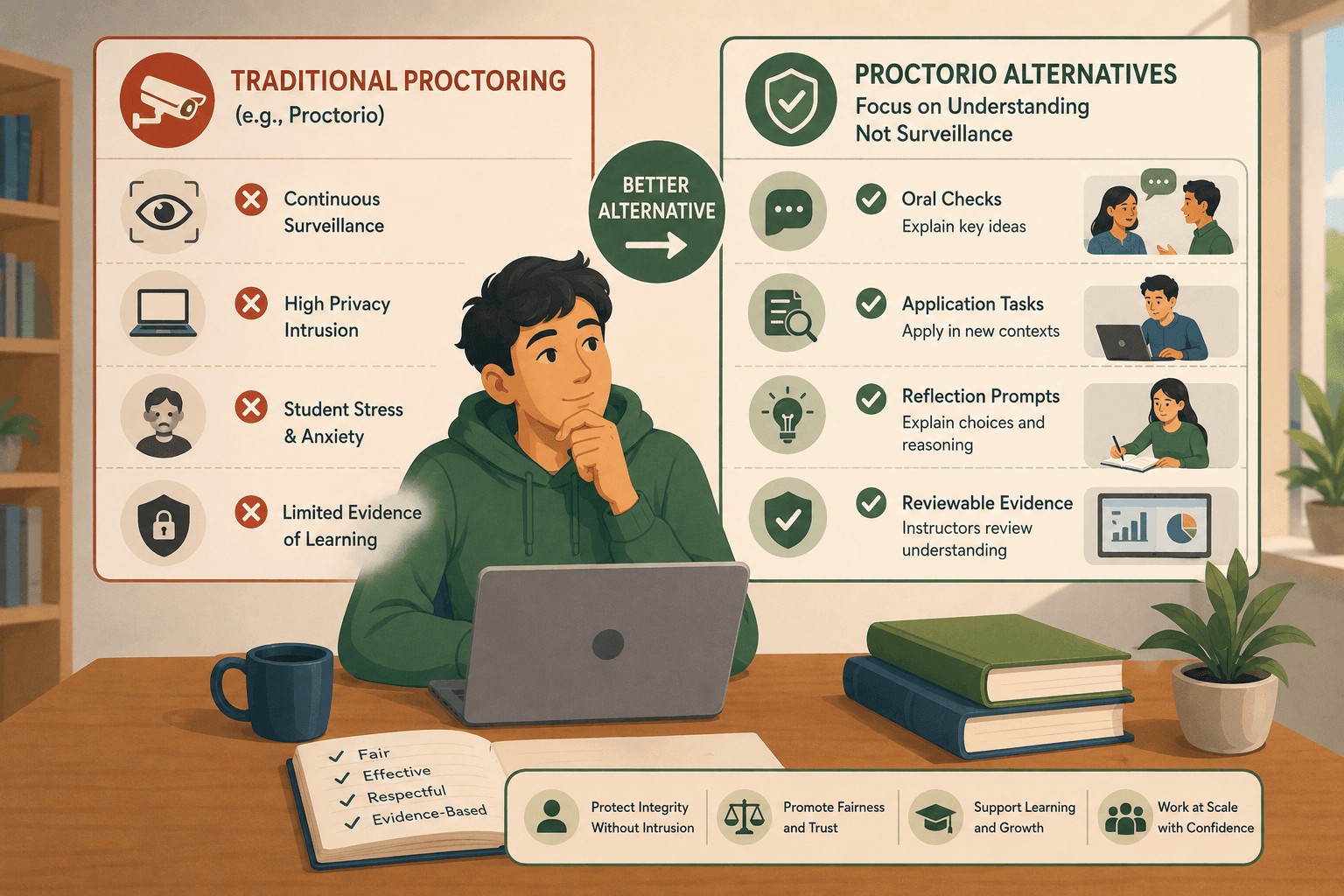
If you are looking for a Proctorio alternative, you are probably not just shopping for a different proctoring vendor. You are trying to solve a harder problem: how do you protect academic integrity online without asking every student to accept a surveillance-heavy testing experience?
That question matters because remote assessment is no longer an emergency workaround. Online, hybrid, and flexible programs are part of normal institutional life. Faculty still need confidence in student work. Students still need fair conditions. Academic leaders still need policies that can survive privacy reviews, accessibility concerns, appeals, and faculty governance.
Proctoring can have a place in some high-stakes contexts, but it is not the only model. This guide gives you a practical way to compare Proctorio alternatives by decision type, not by vendor slogans. It focuses on workflows that reduce invasive monitoring while giving instructors stronger evidence of what students understand.
Why institutions look for Proctorio alternatives
Institutions usually search for Proctorio alternatives after one of four moments. The first is student pushback. Learners may object to webcam monitoring, room scans, ID checks, recording, or automated behavior flags. The second is faculty frustration. Instructors may find that the tool creates administrative work without resolving the deeper question of whether students understand the material. The third is legal or policy review. Privacy, procurement, accessibility, data retention, and vendor governance all become part of the decision. The fourth is strategic reassessment. A program realizes that proctoring protects a narrow testing format but does not necessarily improve assessment quality.
Harvard Medical School’s discussion of remote proctoring captures the tension well. It notes that students were concerned with surveillance and privacy, while faculty were also concerned about the lack of consistency in the quality and type of testing environment available to each student 1. That is the institutional problem in one sentence. The tool may monitor students, but it does not give every student the same home environment, device reliability, bandwidth, disability accommodation, or stress profile.
Scholarly analysis of online exam supervision technologies raises similar concerns. Coghlan, Miller, and Paterson describe online proctoring as ethically complex because it touches fairness, transparency, privacy, autonomy, liberty, trust, and academic integrity 2. Those are not minor implementation details. They are the exact issues that decide whether an academic integrity system feels legitimate.
| Institutional concern | Why it appears in proctoring reviews |
|---|---|
| Student privacy | Remote proctoring can involve webcams, microphones, screen monitoring, room scans, and identity checks. |
| Equity and access | Students may have different home environments, bandwidth, disabilities, devices, and caregiving responsibilities. |
| Trust | Surveillance can change the relationship between student and institution before any concern exists. |
| Faculty workload | Flag review, incident handling, accommodation requests, and student complaints can create hidden labor. |
| Evidence quality | A recording or behavior flag may not show whether the student understands the course material. |
Once these issues are visible, the procurement question changes. The institution is no longer asking which tool watches students most efficiently. It is asking which workflow creates enough integrity evidence with the least unnecessary intrusion.
Common Proctorio concerns
A fair comparison should avoid caricature. Institutions do not adopt proctoring because they want to make students uncomfortable. They adopt it because they need a way to run exams remotely, protect credential value, and give faculty a sense that standards still matter.
The concern is that surveillance can become the default answer even when the assessment problem calls for something else. A locked-down, watched exam may reduce some forms of misconduct, but it does not prove durable understanding. It also introduces new failure points.
| Concern | What it can look like in practice | Question to ask before renewing a proctoring workflow |
|---|---|---|
| Privacy | Students object to recording, room scans, or biometric-style checks. | Is every data element collected necessary for the academic decision? |
| Accessibility | Students need accommodations that do not fit standardized monitoring rules. | Can the workflow handle disability, neurodiversity, caregiving, and environmental constraints? |
| False suspicion | Behavior flags may reflect anxiety, eye movement, interruptions, or technical issues. | What human review process prevents overinterpretation? |
| Technical friction | Exams are disrupted by bandwidth, device, browser, or extension failures. | How often does the tool create assessment noise? |
| Pedagogical mismatch | The exam format rewards recall under surveillance rather than meaningful application. | Would a different assessment produce better evidence of learning? |
| Governance burden | Procurement, data protection, vendor review, and complaints become recurring work. | Is the integrity benefit worth the institutional overhead? |
UNESCO’s generative AI guidance argues for a human-centered approach to technology in education, including privacy protection and ethical, safe, equitable, and meaningful use 3. That principle applies beyond generative AI. Any academic integrity technology should be judged not only by whether it deters misconduct, but also by whether it preserves fairness, learning, and trust.
Alternative approaches to online integrity
A useful Proctorio alternative is not always another product in the same category. Sometimes the better alternative is a different assessment model. Sometimes it is a lighter integrity layer. Sometimes it is a targeted evidence workflow used only where the stakes justify it.
| Alternative approach | How it protects integrity | When it works best | Tradeoff |
|---|---|---|---|
| Assessment redesign | Makes tasks more specific, applied, iterative, or connected to course context. | Courses where faculty can change prompts, formats, or rubrics. | Requires design time before the term begins. |
| Open-resource exams | Assumes access to materials and tests application, explanation, and judgment. | Disciplines where real-world work is not closed-book. | Poorly written questions can become too easy. |
| Low-stakes distributed assessment | Reduces the pressure on one proctored event. | Courses with multiple learning outcomes and frequent feedback. | Requires grading workflow discipline. |
| Oral checks | Asks students to explain selected answers, methods, or submissions. | High-value assignments, unclear cases, capstones, projects, and sampled reviews. | Manual oral exams do not scale without structure. |
| Evidence-based follow-up | Captures student explanations and stores reviewable records for instructor judgment. | Programs that need fairness, consistency, and documentation. | Requires clear criteria for when follow-up is triggered. |
| Limited proctoring | Reserves surveillance for genuinely high-stakes or accreditation-constrained exams. | Licensure-style contexts or exams that cannot be redesigned. | Still needs privacy, access, and review safeguards. |
The most resilient model is usually layered. You might redesign some assessments, distribute points across the term, use open-resource tasks where appropriate, and reserve targeted follow-up checks for the work that matters most. That gives faculty more ways to see learning without forcing every integrity concern into a webcam monitoring workflow.
This approach also makes academic integrity less dependent on fear. Students know they may need to explain their work. Faculty know they have a process for unclear cases. Administrators know there is a reviewable record if a decision is questioned.
How Pruuva differs from proctoring
Pruuva is not a remote proctoring system. It does not try to watch a student’s room, lock their browser, or infer misconduct from gaze, movement, background noise, or device behavior. Pruuva is an academic integrity evidence platform designed to help educators verify student understanding after submission.
That difference matters for institutions comparing alternatives to Proctorio. Proctoring focuses on controlling the testing environment while the student completes an exam. Pruuva focuses on what happens when the institution needs to know whether a submitted answer, paper, project, or solution is supported by the student’s own understanding.
| Proctoring workflow | Pruuva evidence workflow |
|---|---|
| Monitors the test-taking environment. | Reviews the submitted work and supports targeted follow-up. |
| Flags behavior or conditions that may appear suspicious. | Collects student explanations tied to the work and rubric. |
| Often applies to all students in an exam session. | Can be used selectively, by assignment, risk level, sampling plan, or review need. |
| Produces recordings, logs, or incident flags. | Produces evidence reports with responses, summaries, and instructor-review context. |
| Tries to prevent unauthorized behavior during the assessment. | Helps verify understanding after the student has produced work. |
For some institutions, this is not an either-or decision. A licensure program may still need proctoring for a final exam. But the same institution may not need surveillance for every writing assignment, project, lab report, coding task, or take-home assessment. Pruuva gives those courses another option.
If your team is evaluating this shift, start with Pruuva’s Proctorio comparison page, then review the broader academic integrity comparison hub. If you are ready to test the workflow in a real department or online program, the pilot pathway is the best next step.
Buyer checklist
A good buyer checklist should force the institution to define the academic decision before selecting the technology. Otherwise, the tool category decides the assessment philosophy by default.
| Evaluation question | Why it matters |
|---|---|
| What academic decision will this tool support? | A tool for deterrence, evidence collection, grading support, or appeals will be judged differently. |
| Is the assessment format itself still appropriate? | If the exam measures recall that AI and search can easily reproduce, surveillance may only protect a weak task. |
| What data does the tool collect, and for how long? | Privacy review should focus on necessity, retention, access, and vendor use. |
| What happens when the tool flags a student? | A fair workflow needs human review, student explanation, and clear documentation. |
| How does the process support accommodations? | Integrity systems must work for students with disabilities and varied home environments. |
| Can faculty review evidence without becoming investigators? | The process should reduce ambiguity, not push hidden labor onto instructors. |
| Does the workflow improve learning evidence? | The strongest integrity system should help you understand what students can do. |
The University of Texas at Austin’s AI detection guidance is about detectors rather than proctoring, but its procurement and privacy logic is relevant. It warns that third-party tools used with student work can raise security, privacy, accessibility, intellectual property, and FERPA concerns when not properly contracted and governed 4. Institutions evaluating proctoring or alternatives should apply the same seriousness to vendor review and student data.
FAQ
What is the best Proctorio alternative?
The best Proctorio alternative depends on the assessment problem. If you need to replace surveillance for projects, writing, coding, or take-home work, an evidence-based follow-up workflow may be more useful than another proctoring tool. If you need to run a high-stakes closed-book exam, you may need limited proctoring with stronger safeguards.
Can academic integrity work without online proctoring?
Yes, in many contexts. Integrity can be supported through assessment redesign, open-resource exams, process evidence, oral checks, lower-stakes distributed assessment, and targeted follow-up. The key is to collect evidence connected to learning outcomes, not only evidence of test-taking conditions.
Is Pruuva a replacement for every proctored exam?
No. Pruuva is not a proctoring system. It is best used when educators need to verify student understanding of submitted work and preserve reviewable evidence. Some programs may still use proctoring for specific exams while using Pruuva for assignments where explanation and application matter more.
Why do students object to remote proctoring?
Students may object because remote proctoring can involve surveillance in private spaces, technical requirements, identity checks, recording, and automated suspicion. Concerns often involve privacy, fairness, accessibility, anxiety, and trust 1 2.
How should an institution pilot an alternative?
Start with a course type where proctoring feels mismatched with the learning outcome. Define what evidence instructors need, select a small number of assignments, create neutral student communication, and review results with faculty, students, and policy stakeholders. Pruuva’s institutional pilot pathway is designed for that kind of evaluation.