The Graduation Gap: Why Banning AI Hinders Career Readiness
Banning generative AI in higher education creates a dangerous rift between classroom policies and workplace realities. Here is how to teach AI collaboration while requiring evidence of understanding.
Executive Summary: Academic Integrity at a Glance
For university deans, deans of study, curriculum directors, and career advisors, here is a concise strategic summary of this thesis:
- The Workplace Realities: Generative AI is no longer a novelty; it is an industry-standard multiplier. Modern companies do not hire junior developers or junior marketers to write basic boilerplate from scratch. They hire operators who can direct, audit, and integrate AI systems to produce high-value output at scale.
- The Risk of Prohibition: Universities that ban AI or focus heavily on blocking it are actively widening the "graduation gap." They risk producing graduates who are technically obsolete and unready for modern, AI-collaborative professional environments.
- The Dual-Competence Model: Education must transition to a framework of dual competence—teaching students how to use AI productively while requiring clear evidence of human understanding.
- The Assessment Layer: By using scalable, asynchronous oral checks like Pruuva, departments can permit AI usage in assignments while still reviewing whether each student can explain the core concepts behind their work.
Walk into a modern tech firm, a corporate marketing department, a financial analysis unit, or a law firm today, and you will see a similar scene: professionals working alongside highly capable AI copilots.
Software engineers write code inside IDEs like Cursor and GitHub Copilot, generating boilerplate in seconds and focusing their human cognitive energy on system architecture, database optimization, and edge-case debugging. Marketing teams use large language models to analyze thousands of pages of customer feedback, generate initial copy options, and run predictive analytics on campaign metrics. Financial analysts use AI to draft complex earnings models and automate routine spreadsheet calculations.
In many of these environments, not knowing how to use AI is becoming a professional liability. Companies increasingly seek people who can prompt, critique, and integrate AI outputs while still applying human judgment.
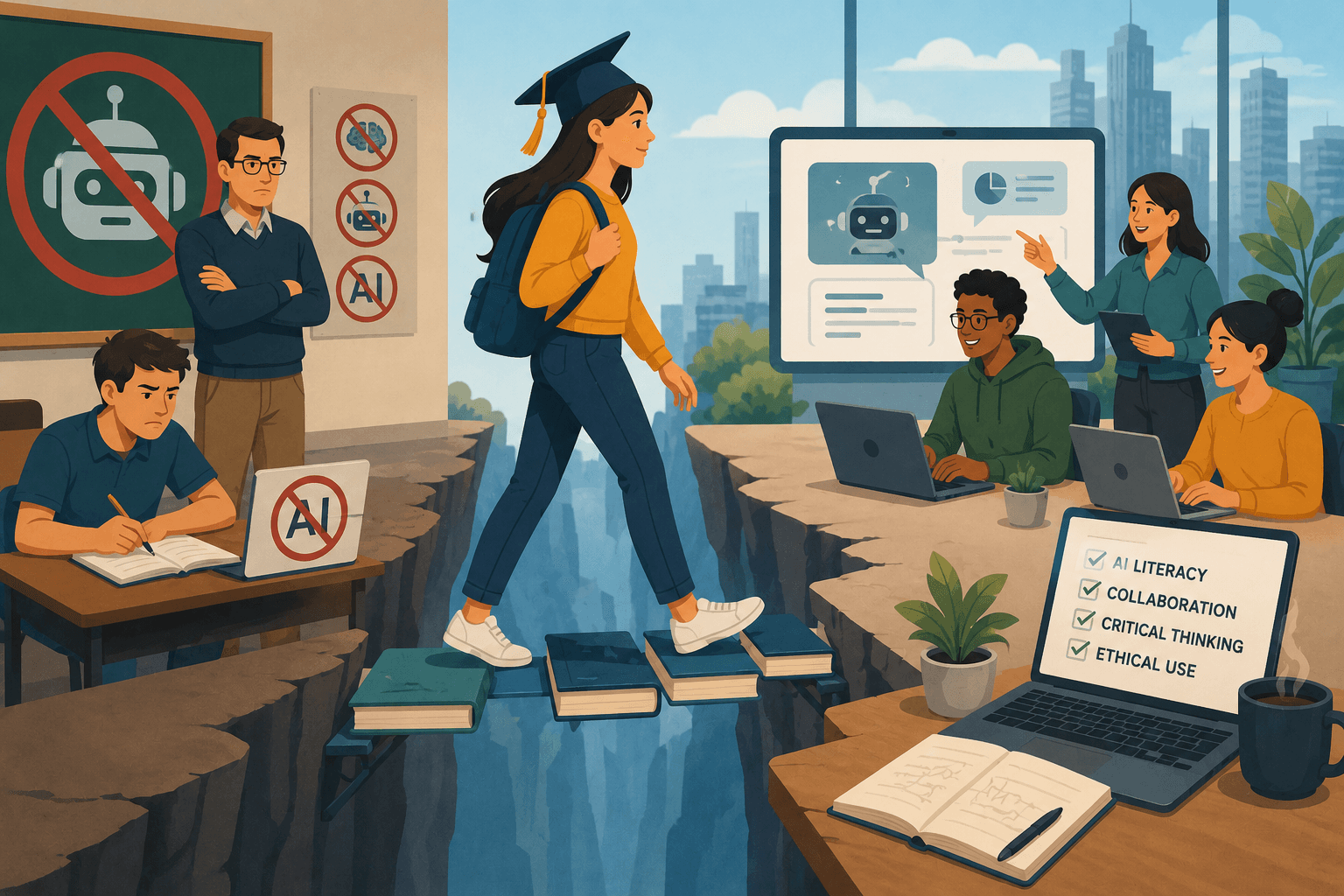
Now, walk into a traditional college classroom down the street.
Here, the syllabus warns of severe disciplinary action for using generative AI. Students write essays by hand in blue-book exams or type under the invasive surveillance of lockdown browsers. Faculty members spend hours running suspicious texts through unreliable AI detectors, trying to prove whether a sentence was written by a human or a machine.
This is the graduation gap—a dangerous and widening rift between the artificial, AI-prohibited environment of higher education and the highly integrated, AI-collaborative reality of the professional world.
By pretending that generative AI is a passing fad or a simple cheating tool, universities risk graduating a generation of students who are fundamentally unready for the modern workforce.
1. The Employer Mandate: The Workforce in the AI Era
In the early days of generative AI, many academic leaders assumed that corporate employers would join them in banning or highly restricting the use of LLMs, citing data security, copyright concerns, and the value of raw human output.
But the economic realities of 2026 have dictated a very different path.
Workforce surveys increasingly show that knowledge-work organizations are adopting generative AI across daily operations. The motivation is simple: productivity gains. A developer using a coding assistant can draft functional code faster. A financial analyst using LLM tooling can process complex compliance reports in minutes instead of days.
As a result, entry-level hiring criteria have shifted dramatically, making generative AI career readiness the primary filter for new graduates.
- The Death of "Boilerplate" Roles: Companies no longer hire junior employees simply to perform routine, easily automated tasks. Basic drafting, translation, and standard formatting are now almost entirely outsourced to machine models. This has completely transformed the value of AI in professional writing; the standard is no longer about writing raw sentences from scratch, but directing and editing high-volume AI drafts.
- The Search for Operators: Employers seek candidates who can manage the AI pipeline. This requires high-order human skills: critical thinking, conceptual auditing, domain expertise, and the ability to ask the right questions.
- The Velocity Expectation: A junior employee is no longer expected to produce one marketing report per week; they are expected to produce five, leveraging AI tools to automate drafting while dedicating human focus to quality control, strategic alignment, and execution.
Old model: execution bottleneck
- •Human drafts
- •Human edits
- •Final document
- •Heavy focus on raw execution
New model: strategic multiplier
- •AI drafts
- •Human audits and refinement
- •Multiplied output
- •Heavy focus on critical reasoning
When a university bans AI, it is not protecting student capability. It is training students for a world that no longer exists—forcing them to spend hours mastering execution styles that are obsolete before graduation.
2. The Prohibition Pitfall: Why Banning AI Fails
Universities that attempt to enforce a blanket ban on generative AI run into several major structural, ethical, and pedagogical walls. The core problem is that prohibition prevents faculty from teaching with AI tools under structured, ethical conditions, driving usage entirely underground.
The Creation of the Equity Gap
Blanket bans do not stop AI usage; they simply drive it underground. This creates a severe equity gap inside the student body:
- The Rule-Bypassers: Students who are willing to ignore the policy will continue using advanced AI models (often paid versions that are highly human-like and untraceable) to complete their work, securing high marks with minimal effort.
- The Rule-Followers: Honest students who follow the syllabus instructions will write everything by hand. Because they do not have opportunities for structured learning and teaching with AI tools in their courses, these students do not gain any literacy in the platforms that their future employers expect them to master.
- The Falsely Accused: Honest students—particularly non-native English speakers or neurodivergent writers whose natural style happens to score high on statistical detection models—face devastating false accusations of cheating, damaging their academic careers and institutional trust.
The Educational Police State
Enforcing a ban forces faculty members to spend less time teaching and more time acting as digital detectives. They are caught in a hostile relationship with their students, relying on untrustworthy AI detectors to police an invisible line.
This environment of mutual suspicion breaks the trust required for deep, transformative education. Students feel under surveillance, and instructors feel exhausted by the constant battle against the machine.
3. Defining Collaborative Competence: The Dual-Competence Model
The solution to the graduation gap is not to surrender to AI, but to transition to the dual-competence model. To prepare students for AI-integrated work, the curriculum must separate learning into two distinct, equally important competencies that students must demonstrate to receive a degree:
AI-multiplied execution
- •Prompt and direct LLMs
- •Increase speed, volume, and formatting efficiency
- •Audit hallucinations and error states
Human understanding
- •Demonstrate personal grasp of concepts
- •Use logical reasoning and conceptual defense
- •Explain choices without external assistance
In this model, the final artifact is not treated as the only proof of competence. Students can use AI to improve execution, while instructors still require evidence that they understand the concepts behind what they produced.
If a student submits a highly polished financial portfolio generated with the help of an AI analyst, they must be prepared to complete an oral walkthrough:
- "Explain why your portfolio allocation shifted when interest rates rose in your model."
- "If we increase the inflation projection by 2%, which of these assets is hit hardest, and why?"
If the student can explain the theoretical underpinnings, defend the trade-offs, and pivot their strategy in real time, they have demonstrated competence. They have shown they can work at the speed of the modern economy while possessing the human expertise required to direct the technology.
Strategic Comparison of Academic Assessment Paradigms
To help university leaders visualize the shift, here is a detailed breakdown of how different assessment strategies handle the reality of modern technology:
| Evaluation Dimension | 1. Traditional Grading (AI Banned) | 2. AI-Unchecked Grading (Unregulated AI) | 3. Dual-Competence Grading (Pruuva) |
|---|---|---|---|
| Classroom Policy | Prohibited. Enforced by lockdown browsers and probabilistic detectors. | Ignored or loosely allowed with no secondary evidence step. | Encouraged or allowed. Focuses on collaborative multiplying. |
| Student Motivation | Compliance-focused. Underground usage driven by economic/time pressure. | Bypassing effort. Outsourcing raw execution without learning. | Interactive tutoring. Deeply understanding the output to defend it. |
| Faculty Role | Digital detective. Spending hours analyzing probabilistic percentages. | Disengaged grader. Scoring AI-written boilerplate without evidence. | Reviewer and mentor. Spotting comprehension gaps in evidence reports. |
| Trust Environment | Suspicion and adversarial friction. Students feel audited by default. | Disconnection. Little to no assurance of who mastered the skills. | Trust-first dialog. Students demonstrate genuine personal understanding. |
| Workplace Readiness | Low. Students graduate with little practice using industry-standard AI tools. | Low. Students can prompt but may fail under basic conceptual pressure. | High (Evidence-backed). Students build AI literacy and demonstrate conceptual depth. |
4. Redesigning Curriculums for Career Readiness
To implement the dual-competence model, academic departments must redesign their curricula and assessment flows. Here is how three major disciplines can transition:
Computer Science & Software Engineering
- The Shift: Stop grading assignments based on basic code correctness or standard algorithms (which AI can generate instantly).
- The Design: Let students use GitHub Copilot to build their projects. Allocate grades based on system design essays, code reviews (where they critique another student's codebase), and asynchronous code walkthroughs where they explain execution flows, explain memory overhead, and debug introduced faults.
- The Career Outcome: Graduates who can write software at the speed of industry, understand architecture, and act as high-value code auditors immediately.
Business & Marketing Programs
- The Shift: Stop grading generic market analyses, SWOT charts, or business plans that are easily generated from standard prompts.
- The Design: Require students to build highly complex, data-rich campaigns using AI tools, then subject them to "crisis pivots" in their defense phases (e.g., "A key competitor has cut prices by 20%—how does your marketing strategy adapt?").
- The Career Outcome: Graduates who can run multi-channel campaigns, digest raw data at scale, and possess the critical thinking required to make real-time management decisions.
Nursing & Health Sciences
- The Shift: Move away from written case-study papers that summarize clinical symptoms (where LLMs are exceptionally good at generating standardized patient notes).
- The Design: Allow AI to assist in compiling standard clinical documentation, but require interactive, asynchronous patient diagnostic walkthroughs where the student must defend their care plan: "Why did you prioritize this clinical intervention over option B?"
- The Career Outcome: Practitioners who can navigate electronic health record AI tools while demonstrating the clinical reasoning required at a patient’s bedside.
5. Bridging the Gap: Asynchronous Evidence at Scale
Redesigning curricula for the AI-collaborative era makes complete pedagogical sense, but academic departments are immediately confronted with the challenge of scale.
If faculty members are expected to conduct deep, interactive oral checks for every assignment in a 300-student lecture, they will run out of hours in a semester.
Pruuva bridges this gap.
Pruuva gives departments a scalable assessment layer for the dual-competence model. By fitting into existing teaching workflows, Pruuva helps departments allow AI usage in assignments because it streamlines the evidence-gathering phase:
- AI Probes Custom to the Work: Pruuva analyzes each student's submission (even if built with AI assistance) and generates 3 highly specific, conceptual oral probes.
- Asynchronous Recording: The student records their answers via their laptop or phone on their own schedule, eliminating scheduling friction for faculty.
- Comprehension Evidence Report: The system distills the student's responses into transcripts, summaries, and comprehension signals. The instructor can focus grading time on the students and concepts that need closer review.
With this approach, universities can reduce reliance on surveillance-heavy tools and unreliable AI detectors while training students for modern, AI-integrated careers with stronger evidence behind grades.
Frequently Asked Questions (FAQ)
Q: If we let students use AI, won't they stop learning the fundamentals?
No. The dual-competence model encourages deeper engagement with the fundamentals. When a student knows they have to complete a short asynchronous oral check about their work, they cannot rely only on copied output. They need to study the AI's draft, understand the terms it used, research the underlying concepts, and prepare to explain the material in their own words.
Q: How do employers view universities that require capability evidence?
Employers value graduates who can use AI without losing command of the underlying work. In a landscape where hiring managers are increasingly skeptical of written resumes, portfolios, and transcript GPAs, a university that can show evidence of student capability has a stronger story to tell. Graduates from these programs leave with practice using AI and a record of explaining their own work.
Q: Does this model disadvantage students who cannot afford premium AI tools?
Institutionalizing this framework can help level the playing field. When AI is banned, students with more resources may still use stronger tools underground. By integrating AI directly into the curriculum, departments can provide clearer access rules, shared expectations, and equal opportunity to build AI literacy.
Conclusion: The New Standard of Trust
Academic deans and deans of study are faced with a critical choice: they can continue trying to police a broken boundary, relying on unreliable detection software to enforce a fragile ban on tools that increasingly shape professional work. Or they can redesign assessment around AI literacy and demonstrated understanding.
Banning AI does not protect academic standards; it merely delays the moment when a graduate’s lack of career readiness is exposed in the real world.
By shifting from text plagiarism to capability evidence, universities can cultivate collaborative AI competence, restore confidence in grading, and graduate professionals who are better prepared for the modern, AI-integrated workforce.
The stronger path is not AI-prohibited. It is AI-literate, evidence-backed, and human-led.