Originality.ai Alternatives for Education: Detection vs Demonstrated Understanding
Originality.ai alternatives for education should do more than estimate whether text looks AI-written. They should help educators verify student understanding with fair, reviewable evidence.
If you are searching for an Originality.ai alternative, the real question may not be whether another detector is more accurate. The question is whether a detector-centered workflow fits the decisions educators actually need to make.
Originality.ai has a clear value proposition. It presents itself as an AI detector and content integrity suite for writers, students, editors, marketers, web publishers, and educators, with tools for AI detection, plagiarism checking, readability, grammar, fact checking, and content quality 1. For publishing teams and content operations, that can make sense. They need to decide whether content meets editorial standards before it goes live.
Education has a different problem. You are not only deciding whether a document resembles AI-generated text. You are deciding whether a student met a learning outcome, whether an academic integrity concern deserves follow-up, whether a student should face a consequence, and whether your process will still feel fair if the student challenges it.
That is why education-ready alternatives to Originality.ai should be evaluated by what happens after the score.
What Originality.ai is designed to do
Originality.ai describes itself as an AI checker, plagiarism checker, content quality tool, readability checker, fact checker, and grammar checker 1. Its homepage emphasizes AI detection accuracy across major AI writing tools and says users should use AI detection as one signal, not a final decision, with a human reviewer kept in the loop 1.
That caveat is important. It recognizes that detection is not the same thing as judgment. In a marketing or publishing workflow, the next step might be to reject a draft, ask a writer for a revision, or check document history. In an education workflow, the next step may involve a student meeting, a grade, an academic integrity referral, an appeal, or institutional documentation.
| Originality.ai-style content review question | Education review question |
|---|---|
| Does this text appear to contain AI-generated content? | Can this student explain and defend this work? |
| Does this draft meet publication standards? | Did the student meet the course learning outcome? |
| Should an editor request changes? | Is there enough evidence to start an academic integrity process? |
| Does the content need further review? | What fair follow-up would clarify the concern? |
This does not mean AI detection has no role. It means the role is narrower than many frustrated educators initially hope. A detector can raise a signal. It cannot conduct the educational review for you.
Why education has different requirements
Classrooms are not content farms, editorial teams, or SEO operations. A student submission is not just an asset to approve or reject. It is part of a learning relationship, a grading process, and often a protected educational record.
The University of Texas at Austin’s AI detection guidance is direct about the institutional stakes. It states that academic affairs should focus primarily on fostering academic integrity through effective course and assessment design rather than increasingly complex efforts to police students 3. It also warns that third-party software used to evaluate student work can raise security, privacy, accessibility, intellectual property, and FERPA concerns if it is not governed through proper university processes 3.
Brandeis University’s AI detection guidance points educators toward research and reporting on false positives, evasion, reliability limits, and bias concerns, including concerns for non-native speakers and students underrepresented in higher education 4. Turnitin’s own AI writing report guidance says its model may misidentify human-written, AI-generated, and AI-paraphrased text, so it should not be used as the sole basis for adverse action against a student 2.
Those concerns create a different evaluation standard for education.
| Education requirement | Why document-level detection is not enough |
|---|---|
| Due process | A student needs a fair chance to explain the work before serious action. |
| Learning alignment | The evidence should connect to the course outcome, not only to text style. |
| Accessibility | The process should work across language backgrounds, disabilities, and varied learning contexts. |
| Privacy and governance | Student work, identity, and records need careful handling. |
| Instructor usability | Faculty need a consistent review path, not just a score that creates more uncertainty. |
| Appeals readiness | The institution needs documentation that shows how judgment was reached. |
The more serious the consequence, the more important these requirements become.
Detection vs demonstrated understanding
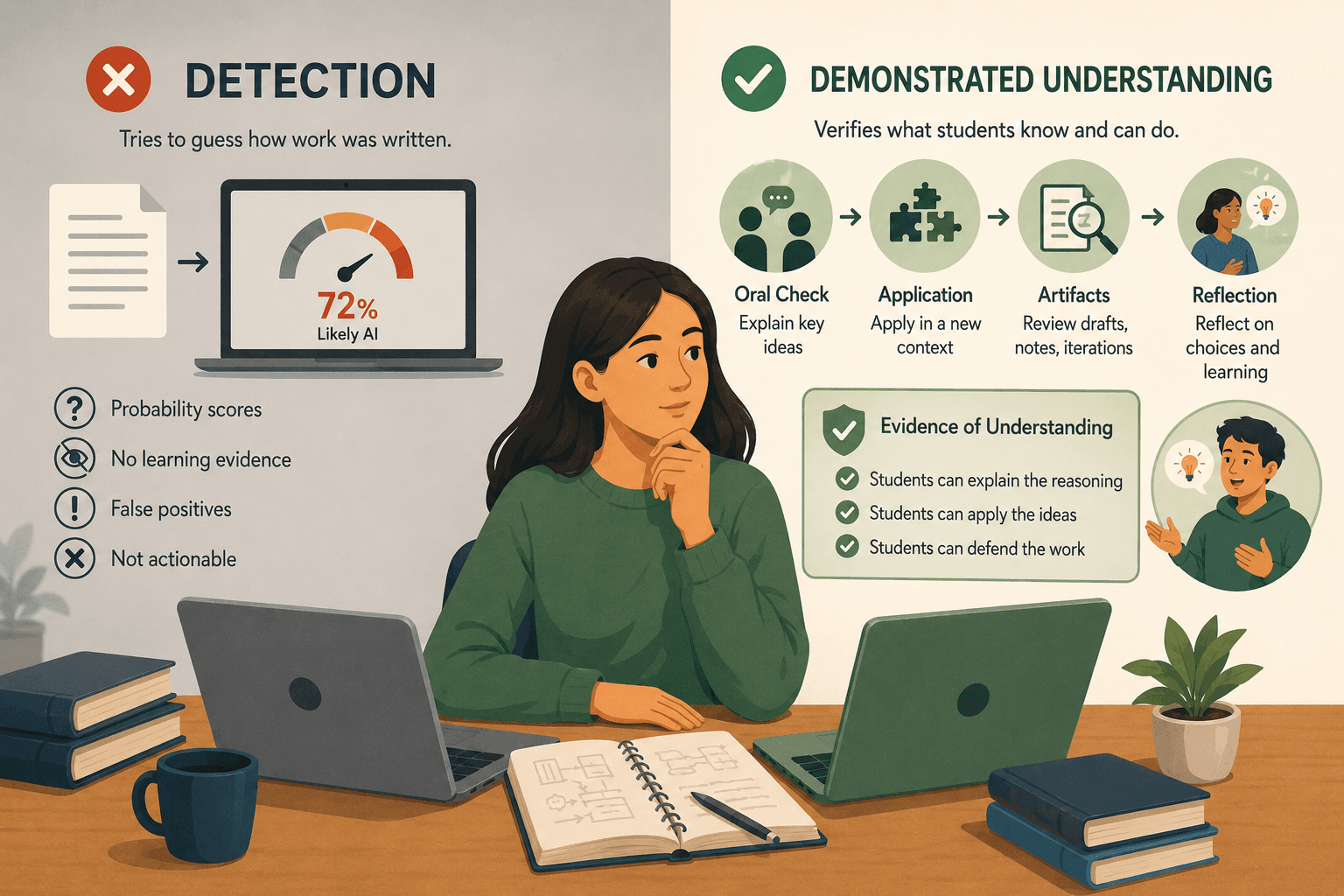
Detection asks whether the submitted document has statistical patterns associated with AI-generated text. Demonstrated understanding asks whether the student can explain, defend, and apply the work they submitted.
Those questions can overlap, but they are not interchangeable. A student might use AI in a permitted way and still understand the work. A student might submit human-written work they do not understand because they received too much outside help. A multilingual student might write in a polished or formulaic style for reasons unrelated to misconduct. A struggling student might produce messy work that is entirely authentic but still fails to meet the outcome.
An education-ready workflow needs room for those realities.
| Scenario | What a detector can suggest | What an understanding check can clarify |
|---|---|---|
| Polished essay from a usually uneven writer | The text may or may not resemble AI-generated writing. | The student can explain claims, sources, structure, and revisions. |
| Coding solution that works unusually well | A detector may not apply well to code or may be unavailable. | The student can walk through logic, tradeoffs, and debugging choices. |
| AI-permitted assignment | The score may still be high. | The student can describe how AI was used and what decisions they made. |
| Suspected outsourcing | The document alone may be ambiguous. | The student can or cannot connect their explanation to the submitted artifact. |
| Non-native English writing | Style-based signals can be risky. | Focused questions can separate language pattern from subject understanding. |
OpenAI’s discontinued classifier page offers a useful reminder: even a leading AI lab warned that its classifier was not fully reliable and should not be used as a primary decision-making tool 5. Education needs a decision process that assumes uncertainty and then collects better evidence.
What to evaluate in an education-ready alternative
When you compare Originality.ai alternatives for teachers or universities, avoid limiting the review to accuracy claims. Accuracy matters, but it does not answer the workflow question. The better question is whether the tool helps your educators make fair, consistent, reviewable decisions.
| Evaluation criterion | What to look for |
|---|---|
| Evidence type | Does the tool produce evidence of student understanding, or only evidence about the document? |
| Student explanation | Can the student respond, explain choices, and clarify permitted or unpermitted support? |
| Instructor review | Does the workflow help faculty make judgments without turning them into forensic investigators? |
| Policy fit | Can it support courses where AI is prohibited, limited, or allowed with disclosure? |
| Documentation | Are responses, summaries, and notes preserved for review? |
| Privacy and governance | Does the workflow respect institutional requirements for student records and data handling? |
| Scalability | Can the process work beyond a few hand-selected cases? |
A useful alternative should help you answer practical questions. Which submissions need follow-up? What should the student be asked? How should the response be captured? What evidence should the instructor review? What record remains if a decision is challenged?
If the tool cannot help with those questions, it may still be a detector, but it is not a complete education workflow.
How Pruuva fits
Pruuva is not trying to be a better Originality.ai clone. Pruuva is an academic integrity evidence platform for educators who need to verify student understanding.
Instead of stopping at a document-level probability, Pruuva helps you move into a structured follow-up process. The submitted work becomes the basis for targeted oral questions. The student has a chance to explain their reasoning. The instructor receives reviewable evidence connected to the assignment, the response, and the learning outcome.
| If you are using AI detection to... | Pruuva helps you... |
|---|---|
| Decide whether a submission needs attention | Identify what evidence would clarify the concern. |
| Interpret an AI score | Ask the student targeted questions tied to their own work. |
| Support an academic integrity conversation | Preserve responses, summaries, and instructor-review context. |
| Compare classroom AI tools | Evaluate whether the workflow verifies understanding rather than only estimating authorship. |
This is especially useful when your institution wants to avoid accusation-first processes. You can begin from a neutral premise: the student should be able to explain important parts of their work. That premise is clear to students, useful for instructors, and aligned with assessment.
To compare the workflows directly, start with Pruuva vs Originality.ai. If you are evaluating AI-writing detection as a category, use the broader AI detection alternatives comparison. If your team wants to understand the evidence model behind Pruuva, review capability evidence.
FAQ
What is the best Originality.ai alternative for education?
The best alternative depends on the decision you need to support. If you only need a content screening signal, another AI detector may be enough. If you need to make fair academic decisions, look for a workflow that verifies student understanding and preserves reviewable evidence.
Is Originality.ai built for schools?
Originality.ai lists educators among the audiences for its AI detector and content integrity tools 1. The key question for schools is not whether educators can use it. The key question is whether a document-level detection workflow meets institutional requirements for due process, privacy, accessibility, and learning evidence.
How is Pruuva different from Originality.ai?
Originality.ai focuses on AI detection and content integrity checks. Pruuva focuses on academic integrity evidence. It helps educators ask targeted follow-up questions, capture student explanations, and review whether a student can explain and apply the work they submitted.
Is Originality.ai vs Turnitin the right comparison?
Sometimes. If your institution is comparing AI-writing detection tools, Originality.ai vs Turnitin may be relevant. But if the concern is fair academic decision-making, the larger comparison is detection versus demonstrated understanding.
Can AI detection be used as one signal?
Yes, if your institution permits it and the tool is properly governed. But major guidance cautions against using detector results as the sole basis for adverse action 2 5. A fairer workflow collects additional evidence before judgment.