How to Scale Oral Assessment Without Adding Hours to Every Course
Traditional oral exams are useful but hard to scale. This guide explains how structured oral checks can give instructors reviewable evidence without turning every class into a scheduling problem.
Oral assessment has always solved a hard problem in education. When you ask a student to explain their work, you learn things that a polished final submission cannot show. You see whether they understand the method, whether they can connect ideas, and whether they can respond when the task moves even slightly outside the prepared answer.
That is why oral assessment is so relevant in the AI era. Generative AI has made polished artifacts easier to produce, but it has not made human understanding irrelevant. The challenge is scale. A professor may believe in oral checks, but a 200-student course can make the idea feel impossible.
The answer is not to schedule a traditional viva for every student. The answer is to make oral evidence more structured, targeted, and reviewable.
Why traditional oral exams do not scale
Traditional oral exams usually depend on long synchronous meetings, expert judgment in the moment, and manual note-taking. That model can work well for small cohorts or graduate-level defenses, but it becomes difficult when programs need consistency across many students, sections, and instructors.
Before scheduling, note-taking, no-shows, and review.
The scale problem has four parts.
| Constraint | What it looks like in practice | Why it matters |
|---|---|---|
| Time | Instructors need to schedule, conduct, and document each conversation. | The workload can become larger than the original grading task. |
| Consistency | Different instructors may ask different follow-up questions. | Students may experience uneven standards. |
| Documentation | Important judgments may live only in brief notes. | Appeals and moderation become harder. |
| Focus | Long conversations can drift away from the key learning target. | The evidence becomes less comparable. |
If oral assessment is treated as a full replacement for every written assignment, these constraints become overwhelming. If it is treated as a targeted evidence layer, it becomes much more practical.
The shift from oral exams to oral checks
An oral exam tries to assess a broad body of knowledge in real time. An oral check asks a narrower question: can the student explain the work they submitted?
That difference matters. A structured oral check does not need to test everything. It can focus on the most meaningful evidence points in the submitted artifact. The purpose is to reveal ownership, comprehension, and transfer.
| Oral exam | Structured oral check |
|---|---|
| Broad, high-stakes assessment event | Focused evidence layer attached to a submitted artifact |
| Often synchronous and instructor-led | Can be structured, recorded, and reviewed asynchronously |
| Relies heavily on live examiner judgment | Produces artifacts that can be reviewed later |
| Difficult to apply across large cohorts | Easier to trigger for high-risk or high-value submissions |
UNESCO's guidance on generative AI encourages education systems to develop human-centered responses that protect learners and improve teaching practices 1. Structured oral checks fit that principle because they keep the student's understanding at the center of the assessment process.
What a scalable oral check needs
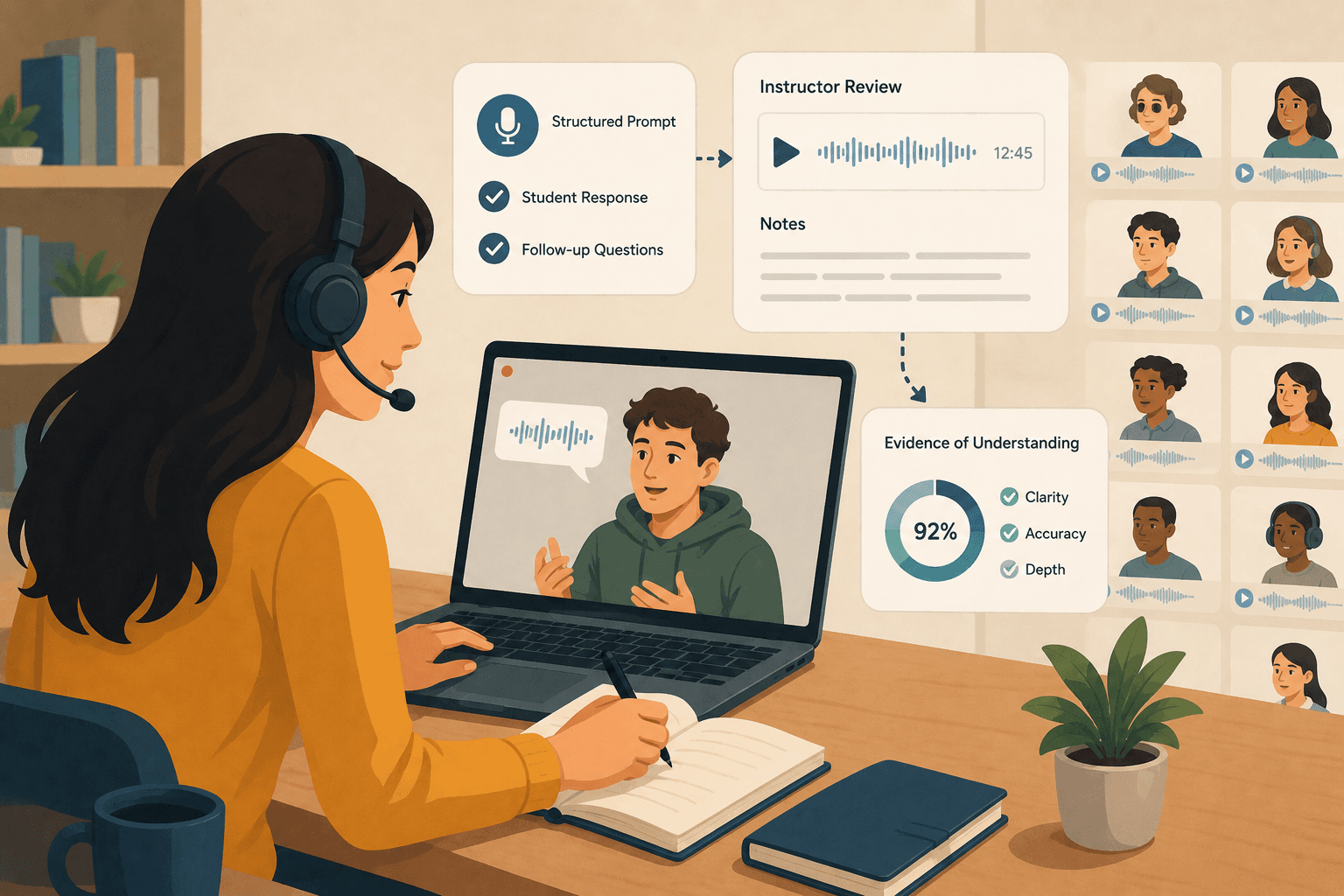
A scalable oral check is not just a video recording. It needs a clear learning target, question structure, evidence capture, and review process. Without those pieces, instructors may collect more media but not more clarity.
The minimum viable workflow has five steps.
- Anchor the check to the submitted artifact. The question should refer to a specific claim, method, calculation, code choice, or design decision.
- Limit the scope. A five-minute targeted response can be more useful than a 30-minute unfocused conversation.
- Ask for reasoning, not performance. The student should explain why they made choices and how they would adapt them.
- Capture reviewable evidence. Transcripts, summaries, recordings, and scoring notes should be available for moderation.
- Connect the result to instruction. Common explanation gaps should inform future teaching, not only integrity decisions.
This approach preserves the instructional value of oral assessment while reducing the operational burden.
How to decide when to use oral checks
Not every assignment needs an oral check. If every small task triggers one, the system becomes burdensome. A better model is to use oral checks where they create the most value.
| Trigger | Example | Why an oral check helps |
|---|---|---|
| High-stakes submission | Final paper, capstone, take-home exam, applied project | The decision matters enough to justify stronger evidence. |
| Conceptual mismatch | Work is polished but inconsistent with prior performance | The check tests understanding without assuming misconduct. |
| Program requirement | Professional accreditation or competency demonstration | The evidence supports defensible program outcomes. |
| Random sampling | A subset of students receives checks | The possibility of explanation can improve assignment ownership. |
| Student support | A learner's written work hides confusion or anxiety | The check can reveal learning needs earlier. |
This trigger model is fairer than detector-first escalation because it does not automatically treat students as suspects. It treats explanation as part of the assessment design.
Designing questions that create evidence
The best oral-check questions are specific enough to connect to the submitted work and flexible enough to show reasoning. Generic questions like "Did you use AI?" rarely create useful evidence. Better questions ask the student to reconstruct the thinking behind the submission.
| Weak prompt | Stronger prompt |
|---|---|
| Did you write this yourself? | Walk me through how you developed the argument in paragraph three. |
| What is your essay about? | Why did you choose this evidence instead of another source? |
| Explain your code. | What would break if this function received an empty input? |
| What did you learn? | Which course concept changed how you approached this problem? |
The stronger prompts do not require the student to perform perfectly. They ask for evidence of understanding. That evidence can be used alongside the written submission, rubric, draft history, and instructor judgment.
What institutions should document
A scalable oral-check program needs documentation because documentation protects everyone. It helps instructors make consistent decisions, and it helps students understand how evidence is being used.
| Documentation item | Purpose |
|---|---|
| Assignment notice | Tells students that they may be asked to explain submitted work. |
| Question rationale | Shows why the selected question was connected to learning outcomes. |
| Transcript or recording | Provides reviewable evidence for moderation and appeals. |
| Instructor summary | Captures the judgment in plain language. |
| Outcome category | Separates strong evidence, partial evidence, and insufficient evidence. |
Google's guidance for helpful content is about search quality, but its underlying standard is useful here too: content should satisfy the user's purpose and demonstrate trustworthy value 2. In assessment, the evidence process should satisfy the educational purpose and make the judgment easier to understand.
How Pruuva helps
Pruuva is designed to make structured oral checks usable for real teams. It helps instructors move from a static artifact to a reviewable evidence package.
A Pruuva-style workflow can support three outcomes at the same time:
| Outcome | What the team gains |
|---|---|
| Better integrity review | The team can evaluate student understanding without relying only on authorship inference. |
| Better feedback | Students receive questions and feedback that relate to their actual work. |
| Better program insight | Common explanation gaps can reveal where instruction, rubrics, or assignment design need improvement. |
This is especially important for B2B education teams, departments, and institutions because the problem is not just one instructor's workflow. It is a repeatable evidence process across courses, cohorts, and policies.
A practical starting point
If you are piloting oral checks for the first time, start small. Choose one assignment where student understanding matters and where polished output alone is no longer enough. Add a short notice to the assignment instructions. Prepare three question types. Decide how evidence will be reviewed. Then compare the results with your existing grading workflow.
You do not need a perfect system before you begin. You need a process that makes the student's understanding more visible than the artifact alone.