AI Detection Alternatives: A Practical Guide to Evidence-Based Assessment
AI detectors try to judge how a submission was produced. Evidence-based assessment asks a stronger question: can the student explain, defend, and apply the work they submitted?
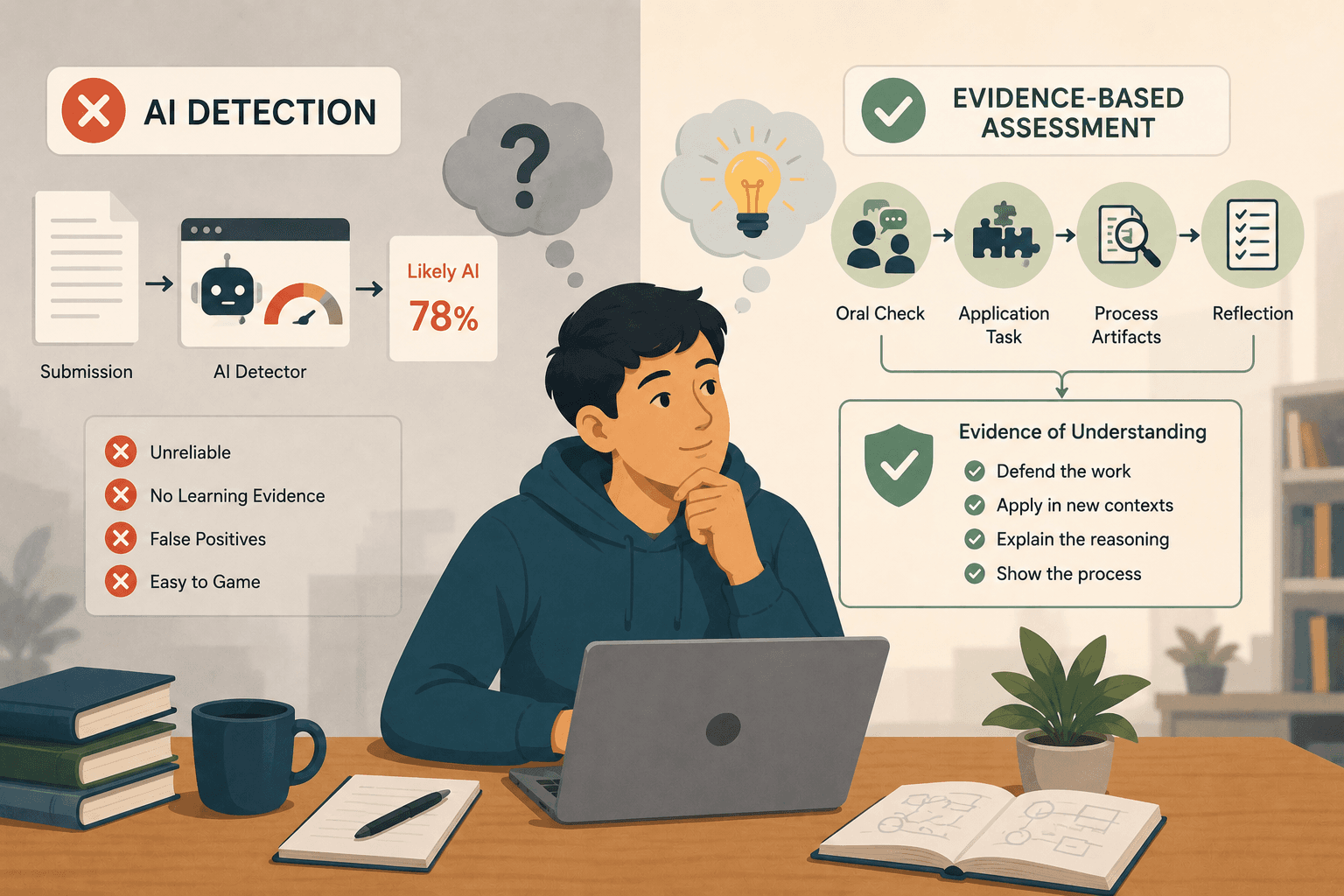
AI detection feels attractive because it promises a fast answer to a stressful problem. A student submits polished work, an instructor worries that the work may not represent the student's understanding, and a detector appears to offer a simple verdict.
The problem is that the verdict is not the same as evidence. A detector tries to infer whether text was machine generated. An assessment process needs to determine whether a student understands the work, can explain key choices, and can apply the underlying concepts in a new situation. Those are related concerns, but they are not the same job.
This guide gives you a practical alternative. Instead of building your integrity process around detection, you can build it around capability evidence: structured signals that show whether the student can explain, defend, and transfer the work they submitted.
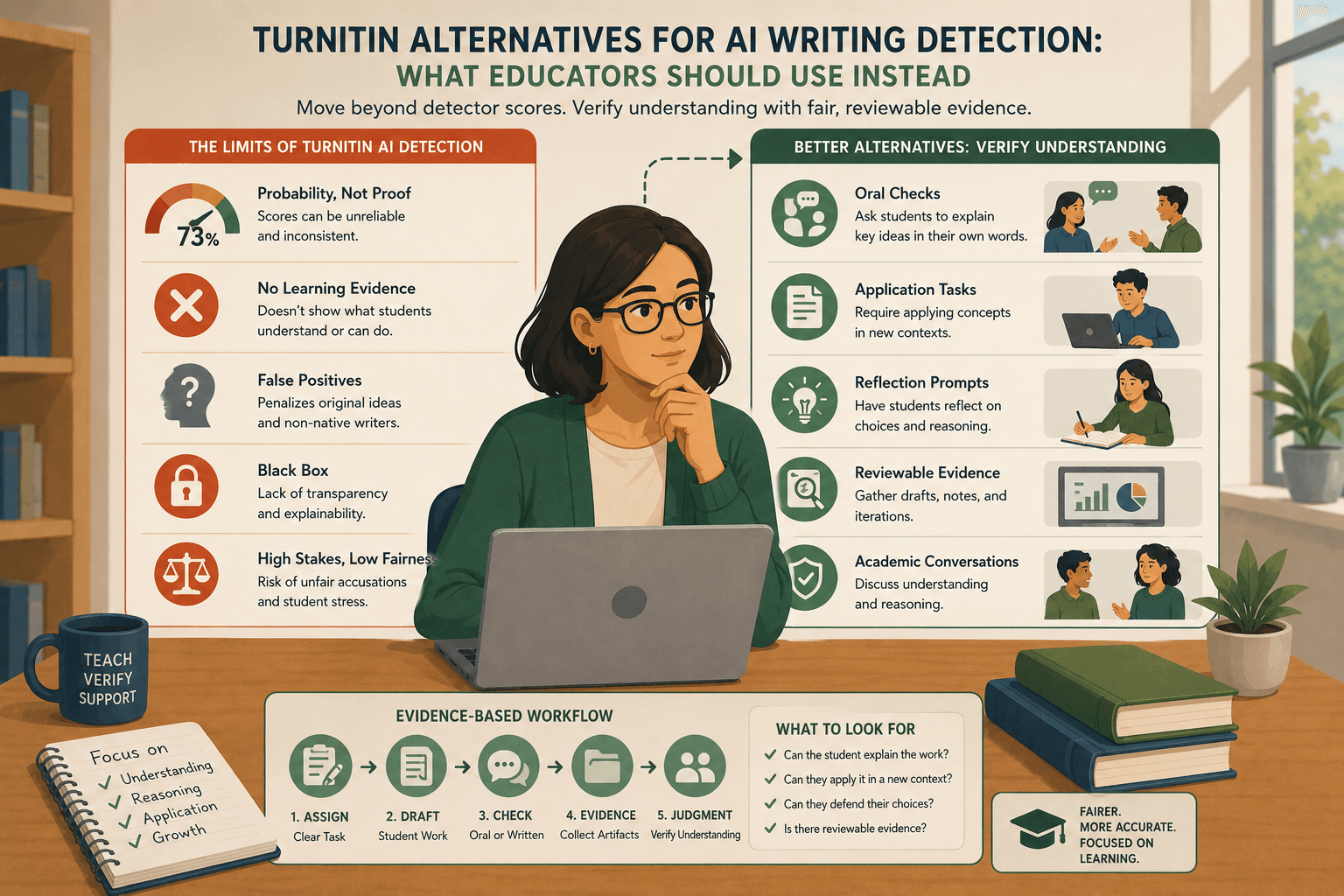
The core problem with AI detection
AI detectors are tempting because they appear to reduce a complex academic judgment into a single output. But higher education does not only need a probability score. It needs a fair, reviewable process that supports student learning, instructor confidence, and institutional trust.
A detector-centered workflow usually follows this pattern:
| Step | What happens | Why it breaks down |
|---|---|---|
| Submission | The student submits writing, code, or another artifact. | The artifact may be assisted, revised, translated, coached, or entirely original. |
| Scan | A tool estimates whether the artifact resembles AI-generated text. | The score is a statistical signal, not proof of misconduct. |
| Interpretation | The instructor or institution decides what to do with the score. | The highest-stakes step depends on context the score does not contain. |
| Dispute | The student may contest the result. | The process often lacks enough learning evidence to resolve the disagreement constructively. |
OpenAI publicly withdrew its own AI text classifier because of its low accuracy, which is an important reminder that even leading AI labs have struggled to make reliable authorship detectors for general use 1. UNESCO also emphasizes that education policy for generative AI should be human-centered and should protect learners while developing appropriate pedagogical responses 2.
The key lesson is not that institutions should ignore AI use. The lesson is that authorship inference is a weak foundation for high-stakes academic judgment.
What to ask instead
A stronger question is: what evidence would show that this student understands the submitted work?
That question shifts the assessment process from policing provenance to checking comprehension. It also gives instructors a better path when AI use is permitted, partially permitted, or difficult to prove. If a student can explain their method, defend their choices, answer targeted questions, and apply the same concept elsewhere, the institution has stronger learning evidence than a detector score can provide.
Old paradigm: provenance
- •Focuses on the artifact
- •Asks how the text was written
- •Relies on policing and detection
- •Weakens as models advance
New paradigm: comprehension
- •Focuses on the student
- •Asks what the student understands
- •Relies on evidence and growth
- •Works across AI-use policies
You can use this shift without abandoning academic integrity. In fact, it often makes integrity more concrete because it ties judgment to observable student performance.
Four alternatives to AI detection
No single alternative solves every integrity problem. The best approach is usually a layered assessment model, where each layer creates a different kind of evidence. The table below gives a practical menu for instructors, program teams, and academic integrity leaders.
| Alternative | Best use case | Evidence produced | Limitation |
|---|---|---|---|
| Process artifacts | Longer projects, writing assignments, labs, design work | Drafts, notes, version history, research logs | Can be fabricated or overproduced if used alone |
| Reflection memos | Assignments where judgment matters | Student explains decisions, tradeoffs, and learning | Works best when prompts are specific |
| Oral checks | High-value assignments or uncertain submissions | Student explains and defends the submitted work | Hard to scale manually without structure |
| Authentic transfer tasks | Courses focused on application | Student applies concepts to a new scenario | Requires thoughtful prompt design |
The goal is not to make every assessment impossible to game. The goal is to make the assessment better aligned with learning. Google's guidance on helpful content asks whether content provides original value, satisfies the reader's goal, and demonstrates trustworthy expertise 3. Academic assessment can use a similar principle. The strongest assessment is not the one that merely catches suspicious output. It is the one that shows whether the learner has achieved the intended outcome.
How oral checks become practical
Traditional oral exams are powerful, but they are expensive in time. If one instructor spends 20 minutes with each student in a 180-person course, the model collapses before it starts.
Structured oral checks are different. They do not need to recreate a full viva for every student. They can target the highest-signal moments in a submitted artifact:
- Ask the student to explain one important choice they made.
- Ask why they rejected an alternative.
- Ask how they would adapt the answer to a new constraint.
- Ask them to interpret a detail that appears in their own submission.
- Ask them to connect the work to a course concept.
The evidence comes from the match between the submitted work and the student's explanation. A confident student may still make small errors, and a nervous student may still show genuine understanding. The process should be designed to surface comprehension, not to trap students.
A simple operating model for teams
If your institution is currently relying on AI detectors, you do not need to replace every policy at once. Start with a narrow workflow for assignments where the stakes are high or the risk of outsourcing is especially visible.
| Phase | Implementation move | Practical output |
|---|---|---|
| Policy | Define when an oral check is used. | A short policy note that frames the check as evidence gathering. |
| Assignment design | Add one sentence telling students they may be asked to explain their work. | Students understand that comprehension matters. |
| Question design | Generate targeted questions from the submitted artifact and rubric. | The check is specific rather than generic. |
| Review | Store transcript, summary, and instructor notes. | The decision becomes more transparent and reviewable. |
| Improvement | Use common gaps to improve instruction. | Integrity work feeds back into teaching. |
This model helps both instructors and students. Instructors get more context before making a judgment. Students get a process that is less dependent on opaque scoring and more connected to learning.
Where Pruuva fits
Pruuva is built for institutions that want to move from suspicion to evidence. A submitted artifact can still matter, but it becomes the starting point for structured questions rather than the entire basis of judgment.
The practical workflow is simple. Pruuva reviews the submitted work, helps generate targeted oral checks, captures student responses, and organizes the results into evidence an instructor can review. That evidence can support grading, academic integrity conversations, feedback, and program-level learning insights.
If your current workflow ends with a detector score, your team is still left asking what the score actually proves. If your workflow ends with capability evidence, your team can ask a better question: does the student's explanation support the work they submitted?
A quick checklist for your next course
Use this checklist when you are redesigning an assignment that currently depends on detection or suspicion.
| Question | Why it matters |
|---|---|
| What should a student be able to explain after completing this task? | It clarifies the actual learning target. |
| Which parts of the submission reveal meaningful choices? | It shows where oral questions should focus. |
| What would a weak but honest explanation look like? | It reduces the risk of confusing nervousness with misconduct. |
| What would an outsourced or shallow explanation look like? | It helps reviewers focus on capability rather than style. |
| How will the evidence be stored and reviewed? | It makes the process more consistent and fair. |