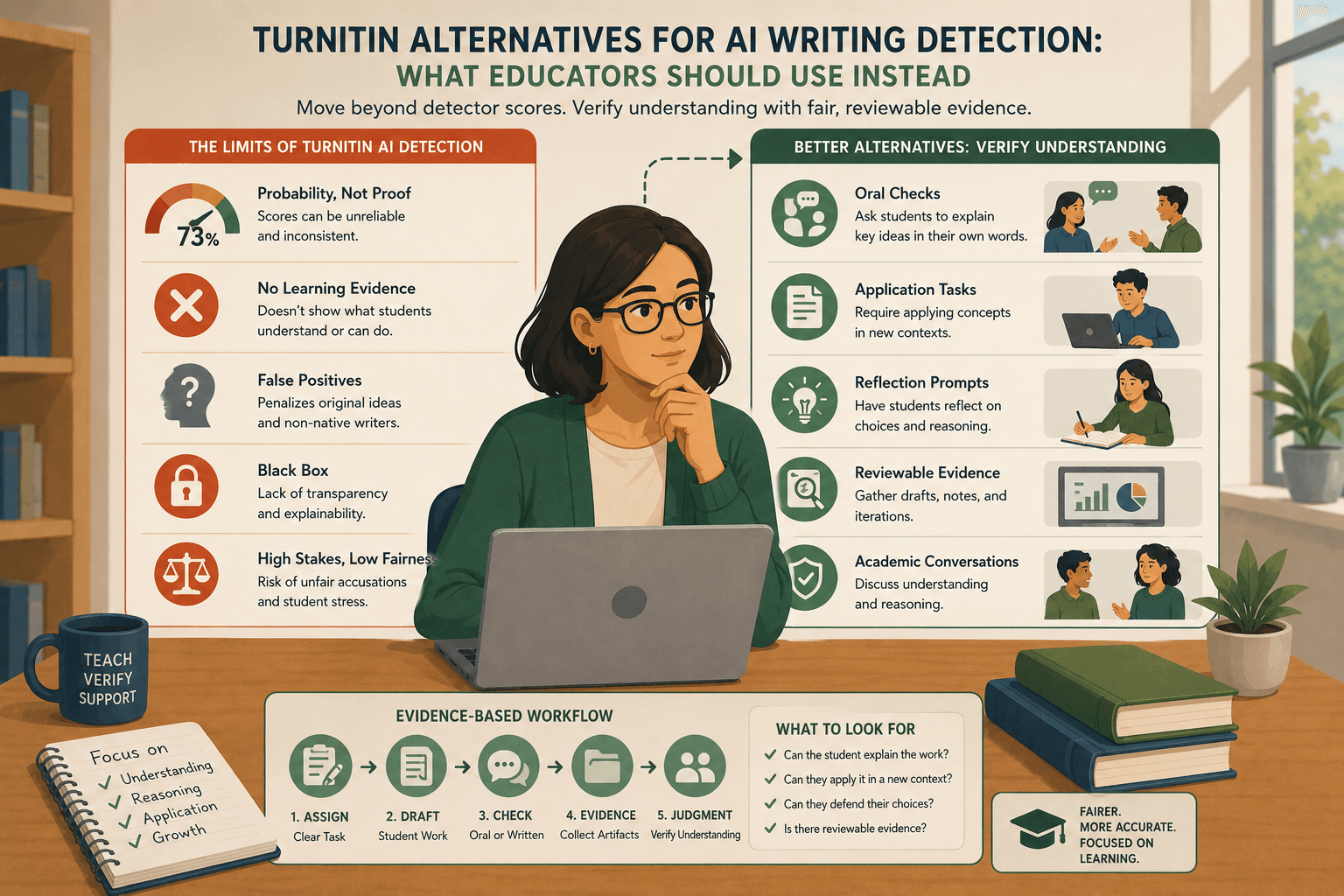
GPTZero Alternatives for Teachers: Move From AI Scores to Understanding Evidence
A teacher-focused guide to GPTZero alternatives that explains when AI detection helps, where it falls short, and how evidence-based follow-up protects learning.

GPTZero became popular because it gave teachers something concrete at a confusing moment. Students had access to ChatGPT, written assignments suddenly felt harder to trust, and educators needed a fast way to understand whether submitted text might be AI-generated.
That need is real. The problem is not that teachers care about academic integrity. The problem is that an AI score can look more decisive than it is.
GPTZero positions its educator tools around AI detection, writing reports, origin analysis, advanced scan, interpretability metrics, plagiarism checks, writing feedback, citation checks, and Google Docs replay.1 2 Those features can help an instructor review a submission. But the central question remains: What should you do with the result?
If the answer is, "Treat the score as proof," the workflow is too fragile. If the answer is, "Use the score as one signal, then verify understanding," the workflow becomes much stronger.
Why teachers look for GPTZero alternatives
Most teachers who search for GPTZero alternatives are not trying to avoid evidence. They want better evidence. They want fewer disputes, fewer false accusations, and a process that students can understand.
GPTZero itself has acknowledged that AI detection is not perfect and recommends using detection as a conversation starter rather than a final judgment.2 That framing is important. A conversation starter can help. A disciplinary shortcut can cause harm.
| Teacher concern | Why GPTZero may feel useful | Why teachers still need an alternative workflow |
|---|---|---|
| A paper sounds too polished | It provides a quick signal | Polished writing is not misconduct by itself |
| A student denies AI use | It gives the teacher a reference point | The score does not establish student understanding |
| A department wants consistency | It can standardize initial review | Follow-up still needs a fair rubric |
| Students use AI in mixed ways | It may identify suspicious text patterns | It cannot fully explain allowed versus prohibited assistance |
| Administrators need records | It produces a report | A report is stronger when paired with student evidence |
The best alternative is not necessarily another detector. It is a workflow that turns uncertainty into reviewable evidence.
The limitation of probability-based review
AI detectors are pattern recognition tools. They estimate whether a text resembles machine-generated writing. That can be useful when the question is low stakes, but classroom decisions are rarely low stakes.
A Stanford SCALE repository summary of research on GPTZero reports that GPTZero identified most fully AI-generated papers accurately in the reviewed study, but human-generated essays fluctuated and produced some false positives.3 Brandeis University also warns that AI detection tools can be unreliable, biased against some student groups, and vulnerable to evasion.4
That does not mean GPTZero is useless. It means the tool should not carry more responsibility than it can support.
| Detector output | Safer interpretation | Unsafe interpretation |
|---|---|---|
| High AI likelihood | This work needs follow-up review | This student cheated |
| Mixed result | Some passages may deserve explanation | The student partly cheated |
| Low AI likelihood | No strong detector concern appeared | The work is definitely unaided |
| Writing report | Useful context for instructor judgment | A replacement for instructor judgment |
| Origin analysis | A possible view into process | Complete proof of authorship |
The safest workflow keeps the detector in its proper place: a signal, not a verdict.
What a teacher-focused GPTZero alternative should provide
Teachers do not need more vague suspicion. They need a next step that is fast, fair, and connected to the learning goal.
A strong alternative should help you ask targeted questions. It should help you document the student's response. It should make the process consistent across students. It should also reduce the chance that writing style, language background, or editing support becomes the hidden reason a student receives extra scrutiny.
| Feature to look for | Why it matters |
|---|---|
| Structured evidence checks | They verify understanding instead of guessing authorship |
| Rubric-based review | They make follow-up decisions more consistent |
| Student-visible expectations | They reduce the feeling of surprise accusation |
| Flexible response formats | They support different learners and contexts |
| Reviewable records | They help instructors explain decisions if questioned |
Pruuva was built for this evidence layer. Instead of asking a teacher to decide from a detector score, it helps the teacher collect capability evidence. That can be a short oral check, a concept explanation, a source defense, a revision rationale, or another structured response tied to the submitted work.
A better workflow after a GPTZero result
Imagine GPTZero flags a student's essay as likely AI-generated. A detector-centered workflow might lead the instructor to email the student with an accusation or send the case to academic integrity. That may be appropriate in some severe cases, but it is risky if the score is the only evidence.
A stronger workflow looks different.
First, identify the learning outcome that needs verification. If the assignment was about argument structure, focus on how the claim develops. If it was about research, focus on source selection and synthesis. If it was about technical reasoning, focus on transfer to a new problem.
Second, choose two or three questions that a student with real understanding should be able to answer. Do not ask, "Did AI write this?" Ask questions that reveal the student's relationship to the work.
Third, collect and record the response in a consistent format. The student should know what is being evaluated. The instructor should know what counts as strong evidence.
| Learning goal | Evidence prompt |
|---|---|
| Argument development | "Which paragraph carries the main claim, and what would you revise if the audience disagreed?" |
| Source synthesis | "Explain why this source belongs in the paper and what limitation it has." |
| Concept mastery | "Define the core concept without using the wording from your submission." |
| Process ownership | "What changed between your first idea and your final submission?" |
| Transfer | "Apply the same reasoning to this related example." |
This approach does not ignore the AI concern. It responds to the concern with stronger evidence.
How to compare GPTZero, Pruuva, and other options
If you are choosing between tools, compare them by decision quality, not just detection claims.
| Tool category | Best for | Risk if used alone |
|---|---|---|
| GPTZero-style AI detector | Initial signal and writing pattern review | Turning probability into accusation |
| Plagiarism checker | Source overlap and citation review | Missing AI-assisted synthesis or original-looking misuse |
| Google Docs history | Process visibility when drafts are available | Overvaluing keystroke history or penalizing different drafting styles |
| Oral exam | Direct explanation and defense | Scaling burden and inconsistent documentation |
| Pruuva | Structured evidence of understanding | Requires clear assignment goals and rubric design |
Pruuva is not trying to be a better probability score. It is solving the next-step problem. When a teacher is unsure whether a submission reflects genuine learning, Pruuva helps gather evidence that the student can explain and apply the work.
When GPTZero can still be useful
GPTZero can still play a role. It may help an instructor notice a paper that deserves closer review. It may be useful for low-stakes conversations about responsible AI use. It may help a department understand patterns across submissions.
But if the decision affects grades, misconduct records, scholarships, or trust between student and instructor, the score should not stand alone.
A fair AI-era assessment system needs multiple layers. It needs clear policy, better assignment design, a consistent follow-up process, and evidence that connects directly to learning.
The practical alternative for teachers
If you are a teacher comparing GPTZero alternatives, choose the tool that helps you answer the classroom question, not just the authorship question.
The classroom question is not, "Can I detect AI perfectly?" It is, "Can I verify that this student understands the work they submitted?"
That is where an evidence-based workflow wins. It gives students a fair chance to demonstrate learning. It gives teachers a stronger basis for decisions. It gives departments a process they can defend.
And it moves the conversation where it belongs: away from guessing how a sentence was produced, and toward verifying what a student can actually do.