Designing Authentic Assignments in the Age of Generative AI
Stop trying to write 'AI-proof' assignments. Here is how to design authentic assessments that integrate AI and require students to demonstrate understanding.

Executive Summary: Academic Integrity at a Glance
For busy educators, instructional designers, and academic directors, here is a quick overview of how assessment design must adapt in the AI era:
- The Myth of "AI-Proofing": Attempting to write prompt workarounds or hyper-niche instructions to defeat large language models is a losing battle. Many prompt-level restrictions can be bypassed with simple formatting, advanced custom instructions, or model upgrades.
- The Authentic Reframe: Instead of banning or evading AI, authentic assessment design assumes the student will use AI, shifting the focus to how they critique, apply, and explain the generated ideas.
- Actionable Blueprints: We provide three concrete blueprints:
- The Iterative Essay (tracing development and defending revisions).
- The Code Walkthrough (building with Copilot, explaining execution and architectural trade-offs).
- The Case Application (applying theory to dynamic, local, or highly specific problems).
- Scalable Evidence: Scaling oral checks for large classrooms is made possible through asynchronous, adaptive probing—restoring confidence in grading without invasive surveillance.
Walk into almost any university faculty lounge or instructional design workshop today, and you will hear a similar conversation: educators trying to figure out how to write "AI-proof" assignment prompts.
Some suggest focusing on extremely recent local news. Others recommend requiring students to write about niche personal experiences, analyze obscure PDFs, or follow hyper-congested formatting constraints. The hope is that by making the prompt specific or bizarre enough, tools like Claude or ChatGPT will fail, and the student will be forced to write the assignment by hand.
This approach is well-meaning, but it is fundamentally flawed. It is a temporary band-aid on a structurally broken assessment paradigm.
Trying to design an "AI-proof" prompt is a game of diminishing returns. The answer is not to keep adding barriers against AI; the answer is to redesign the assessment itself so that it expects AI assistance and still requires the student to demonstrate understanding.
1. The Futility of "AI-Proofing" Assignment Prompts
To understand why prompt-level workarounds are a losing battle, we have to look at how large language models evolve.
When ChatGPT first launched in late 2022, it was relatively easy to break it by asking for analysis of events after its knowledge cutoff or demanding obscure formatting. But by 2026, those limitations have largely vanished. Modern models are connected to real-time search, can process thousands of pages of context in seconds, and can reason through complex logic problems.
If you attempt to outsmart an LLM with obscure prompts, you will run into several structural walls:
The Prompt Bypass Loop
No matter how complex your prompt constraints are, a student can bypass them with a simple "meta-prompt."
For example, if an instructor requires a student to analyze a hyper-niche local community issue from the past 48 hours and include three specific formatting rules, a student does not need to write it themselves. They simply copy the entire grading rubric and prompt instructions, paste them into a search-enabled LLM, and write:
"Search the web for the local news regarding X that occurred yesterday. Analyze it using the attached rubric, and strictly apply the three formatting rules listed in section B."
The model will output a perfect response in under 30 seconds.
The burden shifts to instructors, who must grade increasingly narrow submissions.
The Pedagogical Penalty
When you restrict your assignments to make them "AI-proof," you are often forced to choose bad pedagogy.
To bypass AI, instructors often find themselves asking narrower, more rigid, and less interesting questions. Instead of letting students explore broad, creative, or deeply intellectual themes, they force them to write about highly specific, isolated details that are easy to grade but boring to write.
By bending your curriculum to fight the machine, you end up teaching students how to write rigid, robotic, and highly structured prose—the exact style that AI is best at producing.
2. What Makes an Assessment "Authentic"?
If prompt-proofing is a dead end, what is the alternative? The answer lies in authentic assessment design.
An authentic assessment is an evaluation method that requires students to perform real-world tasks, apply their knowledge to novel situations, and explain the cognitive processes behind their work. It shifts the grading standard from reproducing static information to demonstrating dynamic capability.
Traditional assessment
- •Focuses on memorization or recall
- •Evaluates a static final paper
- •Assumes one correct path
- •Can be outsourced to AI text tools
Authentic assessment
- •Focuses on real-world utility
- •Evaluates the thinking process
- •Values adaptability and defense
- •Requires human cognitive ownership
In the AI era, authentic assessment design is guided by three core principles:
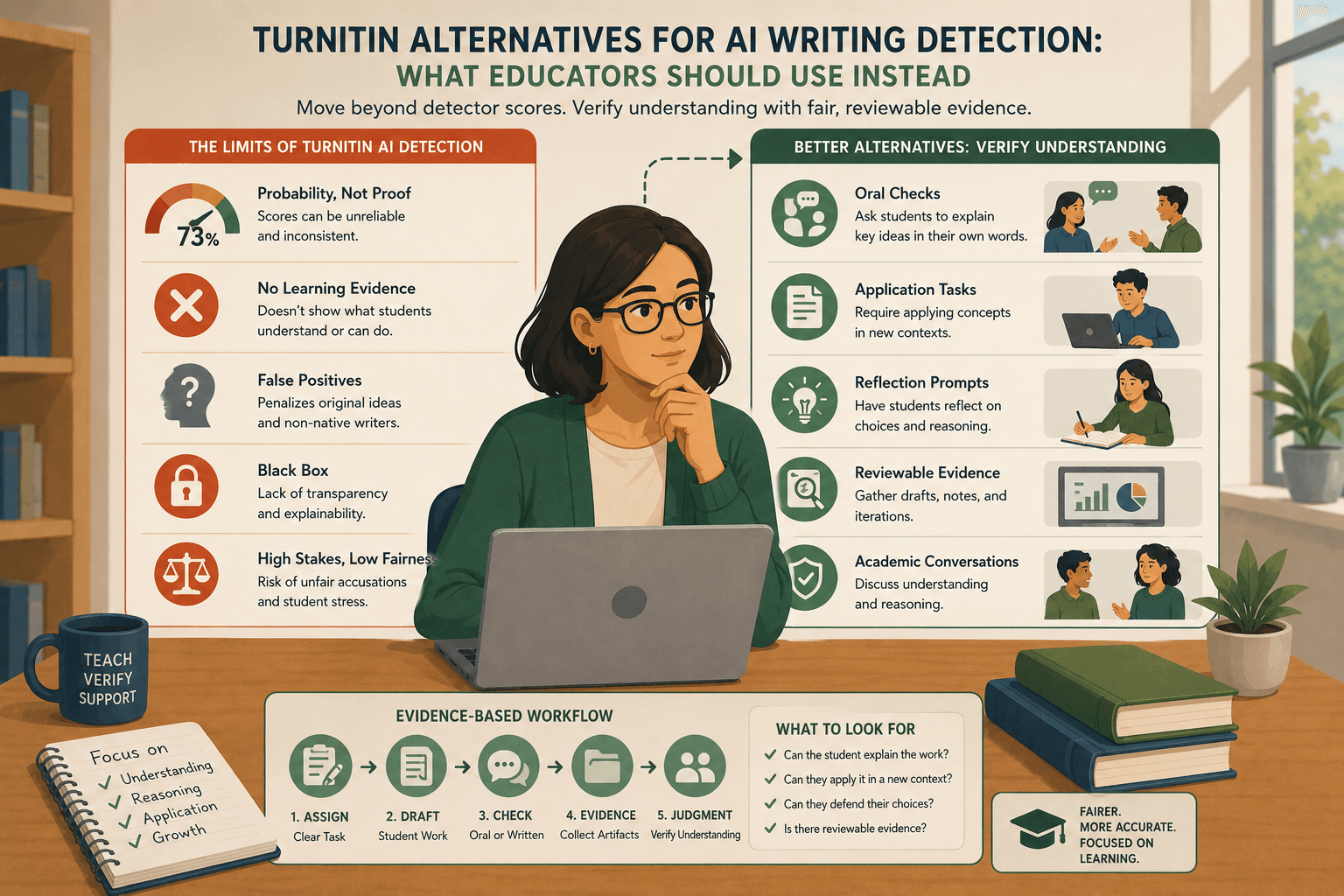
- AI is Expected: The assignment design assumes the student will use AI. Rather than trying to catch AI usage, the instructions explicitly guide the student on how to use AI as a collaborator.
- Focus on the Process, Not Just the Product: Grading rubrics are split to evaluate the student’s iterative choices, critiquing capabilities, and architectural decisions, rather than just the final text block or code repository.
- Required Comprehension Check: The written or coded artifact is not the end of the assignment. To receive credit, the student must show they understand what they submitted by explaining, defending, or refactoring it.
3. Three Authentic Assessment Frameworks
Here are three concrete, copy-pasteable assignment frameworks that educators and instructional designers can deploy immediately in their syllabi.
Framework 1: The Iterative Essay (Humanities & Social Sciences)
Instead of grading a single final draft, grade the student's ability to develop, critique, and defend an argument over time.
- The Prompt Structure:
- Phase A (AI Generation & Critique): The student asks an LLM to generate an initial 500-word argument on a complex prompt. The student must submit the AI output alongside a 300-word human critique highlighting logical fallacies, weak evidence, or missing historical perspectives in the AI's text.
- Phase B (Revision & Expansion): The student rewrites and expands the essay, integrating primary source citations, lecture notes, and classroom discussions to address the gaps they identified in Phase A.
- Phase C (The Comprehension Defense): The student must defend their revised essay by answering adaptive, oral probes: "Why did you replace the AI's argument on X?" or "How does your primary source citation challenge the AI's original conclusion?"
Copy-Pasteable Syllabus Language:
"For the Research Essay, you are required to use generative AI to draft your initial outline. Your grade will be split: 30% on your written critique of the AI’s draft, 40% on your revised and expanded final paper, and 30% on your oral defense of the changes you made."
Framework 2: The Code Walkthrough (Computer Science & Engineering)
Instead of grading code that can be generated instantly by GitHub Copilot, grade the student's ability to explain, debug, and optimize that code.
- The Prompt Structure:
- Phase A (Build): The student is given a functional requirement (e.g., build a debounced search bar component in React). They are encouraged to use whatever AI assistants (Copilot, ChatGPT, Gemini) they want to generate the code.
- Phase B (Document & Contrast): The student must write a brief comparison of two different technical paths for their solution (e.g., comparing debouncing vs. throttling, or detailing how memory leaks are prevented in their cleanup hook).
- Phase C (The Comprehension Defense): The student completes an asynchronous oral walkthrough where they explain the execution of their code: "If we double the database query size, where does your function encounter a performance bottleneck?" or "Explain why you used this cleanup function on line 14."
Copy-Pasteable Syllabus Language:
"In this programming course, you are welcome to use AI coding assistants to build your projects. However, submitting working code is only the first step. You must complete a 2-minute asynchronous code walkthrough explaining your algorithmic choices to receive full credit. If you cannot explain how your code works, your grade will reflect that gap even if the code compiles."
Framework 3: The Case Application (Professional & Business Programs)
Instead of having students write a generic business plan or case study summary, have them apply a theoretical model to a dynamic, highly specific local context.
- The Prompt Structure:
- Phase A (The Scenario): The instructor provides a local business, non-profit, or community organization that is currently facing a real challenge (e.g., a local coffee shop adapting to a new supply chain restriction).
- Phase B (The Application): The student works with an AI tool to generate a SWOT analysis or marketing strategy for the organization, applying a specific framework from the syllabus (e.g., Porter’s Five Forces).
- Phase C (The Pivot & Defense): The student is given a sudden "pivot constraint" (e.g., "A competitor opens a drive-thru next door"). In their oral defense, they must explain how their strategy adapts: "How does Porter's framework help you respond to this new threat?"
4. Automating the Defense: How to Secure Authentic Assessments
Conducting these authentic assessments is highly effective, but it brings us back to the classic EdTech challenge: scalability.
If an instructor has a class of 150 students, reading iterative essays, checking code, and conducting individual oral walkthroughs for every student is not realistic. It is simply too much grading work for a single professor or teaching assistant.
This is where an academic integrity evidence platform like Pruuva becomes useful. Instead of asking you to choose between blind trust and detector scores, Pruuva starts with the submitted work, asks the student to explain it through asynchronous adaptive checks, and gives you a rubric-linked record you can review before making a grading or integrity decision.
That workflow bridges the gap between progressive, authentic pedagogy and the realities of modern grading workloads:
- Less Scheduling Friction: Students complete oral checks asynchronously, fitting the evidence step into existing homework cycles.
- Submission-Aware Questions: Because the system reviews the student's actual work before generating questions, the oral check is specific to the submission and harder to answer with generic preparation.
- Actionable Educator Reports: The instructor does not have to watch hours of video. Pruuva provides transcripts, summaries, and highlighted comprehension gaps so teachers can review class-wide evidence more efficiently.
Frequently Asked Questions (FAQ)
Q: What if a student uses real-time AI during their oral defense?
Pruuva reduces the usefulness of real-time AI assistance by applying response limits and conversational pacing. When an oral probe is revealed, the student responds within a limited window, making it harder to outsource the answer and easier for instructors to review timing, transcript quality, and response coherence as part of the evidence.
Q: Does this change focus the class too much on "public speaking" skills rather than the actual content?
No. Authentic oral defenses are evaluated based on conceptual comprehension, not performance charisma or presentation polish. Rubrics focus on whether the student accurately explains the underlying mechanics, references their written sources, and exhibits logic. Pruuva also supports text-based response options or extended prep times for students who require specific cognitive accommodations.
Q: How do I map this to our current grading rubrics?
We recommend dedicating a specific percentage of the total assignment score, often 20% to 30%, to a "Comprehension Check" or "Evidence of Understanding" category. If a student submits a technically strong paper but cannot answer basic conceptual follow-ups about their methodology, their grade can reflect that gap.
Conclusion: Embodying Authentic Learning
As AI tools continue to advance, the written artifact will become increasingly automated. Writing a script, formatting a spreadsheet, or drafting a summary are tasks that machines can complete in milliseconds.
What the machine does not replace is the student's responsibility to understand, evaluate, and apply those outputs. The goal of modern education must shift from producing clean documents to developing deep, active capability in our students.
Stop fighting AI only at the prompt level. Embrace authentic assessment design, expect collaboration with technology, and add a structured evidence step so instructors can see whether the learning actually happened.
The next generation of assessment is not about building better walls. It is about building better demonstrations of capability.