Beyond Plagiarism: Rethinking Academic Integrity in the AI Era
Academic integrity policies built around plagiarism don't work in the AI era. It's time to reframe integrity around demonstrated understanding.

Executive Summary: Academic Integrity at a Glance
For busy educators, department leads, and academic decision-makers, here is a concise summary of the core arguments of this thesis:
- The Broken Proxy: Traditional academic integrity relies on detecting text plagiarism. This proxy is obsolete because Generative AI produces unique, non-plagiarized text that escapes traditional database matching.
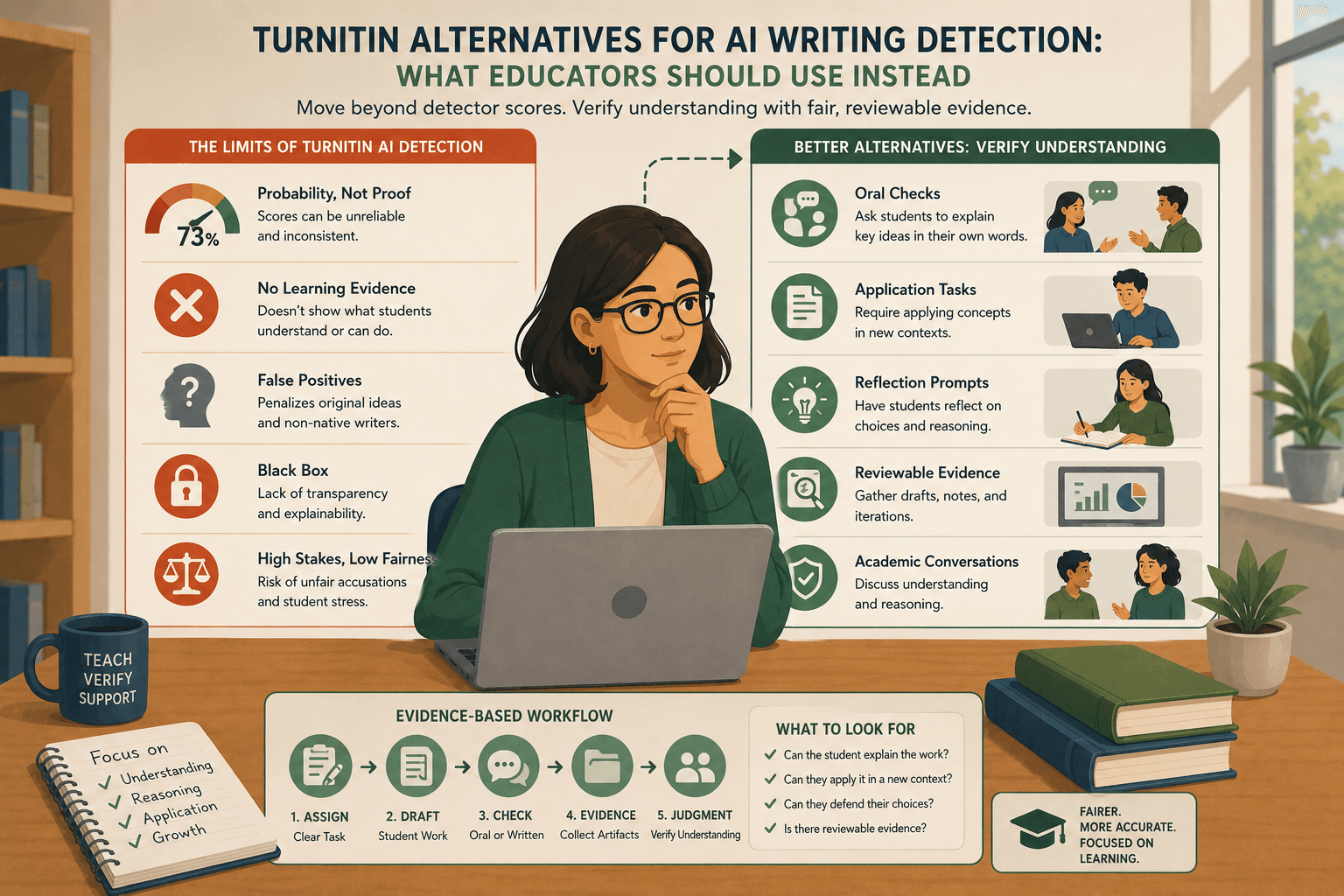
- The AI Detection Dilemma: AI text detectors (Turnitin, GPTZero, Copyleaks) are statistically unstable. They suffer from high false-positive rates, bias against non-native English speakers, and are easily bypassed by standard editing or advanced LLM prompt engineering.
- The Paradigm Shift: Integrity must transition from text provenance (analyzing how or by whom a text was generated) to capability evidence (reviewing what the student can explain, defend, and apply).
- The Solution: Scalable, adaptive oral checks—such as Pruuva—that give educators direct evidence of student understanding without relying on invasive surveillance or probabilistic AI-detection scores.
For as long as modern education has existed, "academic integrity" has been functionally synonymous with a single directive: do not plagiarize. Do not copy someone else’s words. Do not paste text from an external source and pretend it is your own. Cite your sources.
This simple framework spawned a multi-billion-dollar industry of database-matching tools (like Turnitin) and institutional honor codes designed to police the boundary between original writing and copied text. The proxy worked because writing was hard, publishing was slow, and human expression was the only path to producing a structured essay or functional line of code.
Then generative AI arrived, and this entire proxy collapsed.
In the age of generative AI, trying to preserve academic integrity by scanning text for "originality" misses the central issue. The mechanics of creation have changed, and assessment systems need a clearer way to connect submitted work to demonstrated student understanding.
1. The Broken Proxy: Why Plagiarism Checking Is Obsolete
To understand why our current systems are failing, we must first understand the proxy that underpins them.
For decades, educators used the submitted artifact (the essay, the report, the code repository) as a direct proxy for student learning. If a student submitted a 3,000-word analysis of Hamlet, the instructor assumed the student had read the play, developed the argument, and spent hours structuring the sentences.
Plagiarism detectors were introduced to police this proxy. They worked by comparing the submitted text against a massive index of existing web pages, academic journals, and student papers. If the text matched an existing document, the proxy was broken.
Generative AI weakens the link between polished artifacts and student understanding.
Generative AI shattered this relationship. When a student prompts Claude or ChatGPT to write an analysis of Hamlet, the large language model does not copy and paste from an existing database. Instead, it predicts the next most likely token (word or character sequence) based on its training data. The resulting text is entirely novel, syntactically perfect, and statistically unique.
By any traditional definition of plagiarism, this text is original. It has no matching source in a database. It contains no copy-pasted strings.
This creates a fundamental structural mismatch:
- What we measure: The statistical originality of a text string.
- What we actually care about: Whether the student has processed, analyzed, and understood the underlying material.
As long as we treat the written artifact as the full measure of capability, we are optimizing for a proxy that generative AI has made much less reliable.
2. The Statistical Failure of AI Detection
When generative AI first entered classrooms, the initial response from EdTech providers was to build AI content detectors. These tools claim to analyze the statistical properties of text—specifically perplexity (how predictable a word is to an LLM) and burstiness (the variation in sentence length and structure)—to determine if a human or an AI wrote it.
However, this approach is fundamentally flawed for several reasons:
The False Positive Nightmare and Linguistic Bias
Because AI detectors are probabilistic, they do not offer absolute proof. Instead, they calculate a probability score. This leads to a significant false positive rate, which translates to innocent students being falsely accused of academic dishonesty.
Worse, peer-reviewed research (such as the landmark Stanford study, "Our warfare assistant is bias: On the failure of AI detectors on non-native English writers") has demonstrated that AI detectors systematically misclassify writing by non-native English speakers as AI-generated. This occurs because writers learning English often use simpler, more predictable sentence structures and more common vocabulary—exactly the statistical signature of low-perplexity AI text.
The Arms Race We Cannot Win
AI detection is a game of cat-and-mouse where the mouse is moving at exponential speeds. Every time an AI detection company updates its algorithm, underlying LLMs become more sophisticated, expressive, and human-like.
Furthermore, any student can bypass an AI detector by applying simple transformations:
- Using paraphrasing tools (e.g., Quillbot) or custom prompt instructions ("write this with high burstiness and a conversational tone").
- Manually editing 10% of the sentences to introduce human-like stylistic variance.
- Translating the text back and forth between languages.
Because of these structural limitations, major academic institutions—including Vanderbilt, Northwestern, and the University of Waterloo—have officially disabled AI detection features in their learning management systems, citing concerns over equity, reliability, and the legal risks of false accusations.
3. The Reframing: Provenance vs. Comprehension
To solve this crisis, we must shift the fundamental question of academic integrity.
Instead of asking:
"Did AI write this text?" (A question focused on the provenance of the words)
We must ask:
"Does the student understand what they submitted?" (A question focused on the comprehension of the learner)
Old paradigm: provenance
- •Focuses on the artifact
- •Asks how the text was written
- •Relies on policing and detection
- •Weakens as models advance
New paradigm: comprehension
- •Focuses on the student
- •Asks what the student understands
- •Relies on evidence and growth
- •Works across AI-use policies
Once you make this conceptual shift, the entire debate around "acceptable vs. unacceptable" AI use dissolves.
If a student uses a modern coding assistant (like GitHub Copilot or Cursor) to help build a React application, that is not a moral failure; it is an industry-standard development workflow. However, if that student cannot explain why they chose a specific data structure, how their routing works, or how to refactor their state management, they have not demonstrated capability.
Conversely, if a student uses an LLM to outline an essay but can defend their argument in real time, expand on their thesis, and link their points to classroom lectures, they have achieved the core learning objectives of the course.
Academic integrity should be about demonstrated capability and genuine understanding, not about the mechanical provenance of text.
4. Scaling the Solution: Asynchronous Oral Defense
If the strongest evidence of understanding comes from explanation, why did we ever move away from it?
Historically, one of the strongest assessments of capability was the oral viva (or viva voce). Used for centuries in PhD defenses, medical boards, and classical university examinations, the oral defense makes it much harder to rely on work a student cannot explain. A professor sits down with a student, asks them questions about their work, pushes them on edge cases, and directly gauges their comprehension.
But the oral defense has always suffered from a scalability wall.
Before scheduling, note-taking, no-shows, and review.
For a class of 200 students, conducting individual 30-minute oral defense sessions would require 100 hours of faculty time per assignment. As class sizes grew and faculty resources shrank, universities had to abandon the oral viva in favor of written essays, standardized exams, and code submissions—relying on written proxies that AI has now compromised.
The Role of Asynchronous AI Probing
Pruuva addresses this scalability problem by using generative AI to collect evidence, not to guess authorship.
When a student submits an assignment, Pruuva helps instructors run a structured evidence workflow:
- Submission Analysis: Pruuva's AI reviews the specific contents of the student's submission, including key arguments, coding patterns, data citations, and conceptual structures.
- Adaptive Questioning: Instead of generic test questions, the AI dynamically generates 2–3 highly specific, adaptive oral probes customized to that student's submission.
- Asynchronous Recording: The student records their answers (via video, audio, or text) within a tight time limit, preventing them from consulting external AI assistants in real time.
- Real-Time Adaptivity: As the student responds, the AI generates real-time, custom follow-ups based on their previous answers to dig deeper into suspected comprehension gaps.
- Evidence Synthesis: The system compiles an evidence report—including transcripts, response summaries, and comprehension signals—which is sent to the educator's grading workspace.
By moving oral checks into an asynchronous, AI-assisted workflow, educators can review focused evidence instead of scheduling hundreds of live meetings.
5. Practical Action Steps for Institutional Leaders
Transitioning from a plagiarism-based integrity model to an evidence-based assessment model is a cultural and policy shift. Here are three steps institutions can take today:
1. Update Honor Code and Policy Language
Stop trying to write lists of banned tools. Instead, update your syllabus and institutional policies to focus on the expectation of capability.
Recommended Policy Language Template:
"In this course, you are encouraged to use generative AI tools, search engines, and tutoring assistants as learning aids. However, the final submission must represent your own demonstrated capability. You must be prepared to defend, explain, and expand upon any work submitted for credit. Grades are awarded based on demonstrated understanding, and the instructor reserves the right to use oral checks (asynchronous or synchronous) to review capability before releasing final credit."
2. Pilot Evidence Checks in High-Stakes Gateway Courses
Do not try to change every class at once. Focus on courses where integrity is critical for progression:
- Computer Science intro sequences (where Copilot usage is ubiquitous).
- First-year composition courses (where foundational writing skills are established).
- Capstone projects, master's theses, and professional certification programs.
3. Transition Faculty from "Proctors" to "Validators"
Many educators feel exhausted by the "AI arms race"—acting as detectives trying to catch cheaters using unreliable software. Reframe their role. Educators are not proctors trying to prove guilt; they are reviewers of learning evidence, helping students demonstrate what they know. This supports a classroom environment of trust rather than mutual suspicion.
Frequently Asked Questions (FAQ)
Q: Do evidence-based oral checks increase grading workloads?
Not necessarily. When supported by asynchronous tools like Pruuva, the system handles custom probes, collects responses and transcripts, and highlights likely comprehension gaps. The educator receives an organized workspace showing where understanding appears strong and where it needs review.
Q: How does this model handle students with test anxiety or accommodations?
Evidence-based oral checks can be adapted. Unlike high-pressure, live oral exams, asynchronous probing allows students to complete their responses in a quieter environment. Pruuva can support extra response time, text-based answers, and alternative prompt formats so instructors can align the process with approved accommodations.
Q: Why shouldn't we just block AI tools like ChatGPT at the institutional level?
Blocking AI is technically difficult, ethically complicated, and often pedagogically counterproductive. Students have access to LLMs on personal devices, cellular networks, and tools used for everyday writing and research. Knowing how to work responsibly with AI is becoming a professional skill, so institutions need assessment models that allow AI use while still requiring students to explain the underlying concepts.
Q: Is Pruuva an AI detector?
No. Pruuva does not analyze text structure, perplexity, or burstiness to guess if AI was used. It does not output an "AI probability score." Pruuva is an evidence workflow for submitted work: it uses conversational probing to collect direct evidence of student understanding for educator review.
Conclusion: The Path Forward
The generative AI transition in education is not a crisis of student ethics; it is an architecture crisis. We have relied on the written artifact as a proxy for learning for so long that we forgot the artifact was never the goal. The goal was always the student's capability.
By moving beyond plagiarism, reducing reliance on unreliable detection tools, and grounding assessment in demonstrated understanding, institutions can make grading more robust, more equitable, and more focused on human learning.
The next chapter of academic integrity is not just detection. It is evidence.